
The complete guide to every retail store format — from supermarkets and department stores to warehouse clubs, dollar stores, and emerging formats like pop-ups and dark stores. With real examples, size data, and US store location maps for each type.
A side-by-side comparison of all major retail store formats by typical size, product range, pricing strategy, and well-known US examples.
| Store Format | Typical Size (sq ft) | Product Range | Pricing | US Examples |
|---|---|---|---|---|
| Supermarket / Grocery | 40,000–50,000 | Food, beverages, household | Mid-range | Kroger, Publix, Albertsons |
| Fresh / Organic | 25,000–45,000 | Organic, natural, perishables | Premium | Whole Foods, The Fresh Market |
| Limited-Assortment Grocery | 12,000–20,000 | Curated grocery basics | Value / Low | Aldi, Lidl, Trader Joe's |
| Convenience Store | 1,000–3,000 | Snacks, beverages, essentials | Premium | 7-Eleven, Wawa, Sheetz |
| Drug Store | 10,000–15,000 | Pharmacy, health, beauty, general | Mid-range | Walgreens, CVS |
| Wholesale / Warehouse Club | 100,000–150,000 | Bulk food, general merchandise | Low (membership) | Costco, Sam's Club, BJ's |
| Hypermarket / Supercenter | 100,000–200,000 | Full grocery + department store | Low to Mid | Walmart Supercenter, Meijer, Target |
| Discount Store | 20,000–40,000 | Apparel, home, general | Below market | TJ Maxx, Ross, Marshalls |
| Department Store | 100,000–250,000 | Full-line apparel, home, beauty | Mid to Premium | Macy's, Kohl's, Nordstrom |
| Branded Store | 2,000–15,000 | Single brand products | Brand-set | Nike, Zara, H&M, Gucci |
| Franchise Store | Varies widely | Standardized per franchisor | Varies | McDonald's, Subway, Gap |
| Specialty Store | 2,000–60,000 | Single category, deep selection | Mid to Premium | Best Buy, Home Depot, Petco |
| Variety / Dollar Store | 7,000–10,000 | Low-cost general merchandise | Very low | Dollar General, Dollar Tree, Five Below |
| Factory Outlet | 5,000–25,000 | Brand overstock, past-season | Below retail | Nike Outlet, Coach Outlet |
| Mom-and-Pop / Independent | 500–3,000 | Niche, curated | Varies | Local boutiques, bookshops |
| Pop-Up Store | 500–5,000 | Limited, brand-specific | Varies | Seasonal brands, DTC launches |
| Ecommerce | N/A (digital) | Unlimited assortment | Competitive | Amazon, Walmart.com, Shopify stores |
The elephant in the room for any retail store discussion is selling direct to consumers via ecommerce marketplaces such as Amazon, eBay, Alibaba, and Flipkart. Most brick-and-mortar retailers have wholeheartedly adopted ecommerce selling, with Walmart.com, BestBuy.com, and Target.com generating an increasing share of their revenues through online channels.
On the flip side, ecommerce pioneers have also seen value in having a physical retail presence. Amazon acquired specialty grocery chain Whole Foods in 2017 and has since expanded into physical retail with Amazon Fresh grocery stores and Amazon Go cashierless convenience stores.
The lines between ecommerce and physical retail continue to blur. Most major retailers now operate an omnichannel model where customers can buy online and pick up in store (BOPIS), order online for same-day delivery, or browse in store and have items shipped to their home. Ecommerce now accounts for roughly 15–20% of total US retail sales, a share that has grown steadily since 2020.
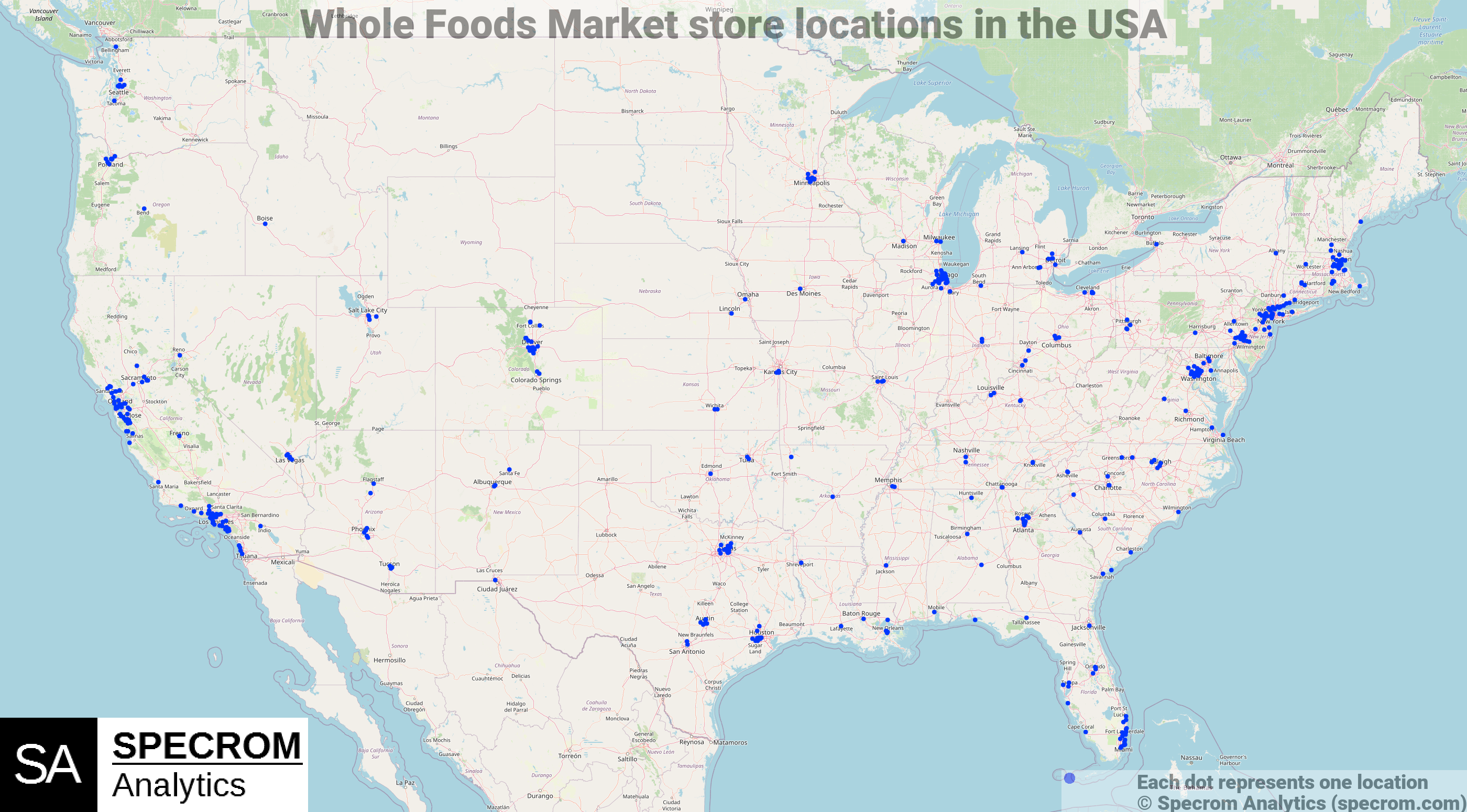 Whole Foods Market store locations in the USA — View dataset & download CSV
A supermarket is a self-service shop offering a wide variety of food, beverages, and household products, organized into sections. It is larger and has a wider selection than the general grocery stores of the early 1900s, but is smaller and more limited in range than a hypermarket or big-box store. The average US supermarket is around 40,000–50,000 square feet.
In everyday US usage, "grocery store" is essentially a synonym for supermarket. Examples include Kroger (the largest US supermarket chain, including Fred Meyer, Harris Teeter, and Ralphs), Publix, Albertsons (Safeway, Vons), and H-E-B.
Different from traditional supermarkets, fresh-format stores emphasize perishables and offer center-store assortments focused on ethnic, natural, and organic products. Examples include Whole Foods Market, The Fresh Market, and Sprouts Farmers Market. These stores typically range from 25,000 to 45,000 sq ft.
A low-priced, value-for-money grocery format that offers a curated but limited assortment of center-store and perishable items. By carrying fewer SKUs (typically 1,500–4,000 vs. 30,000+ in a traditional supermarket), these stores reduce costs and pass savings to consumers. Examples include Aldi, Lidl, Trader Joe's, and Save-A-Lot.
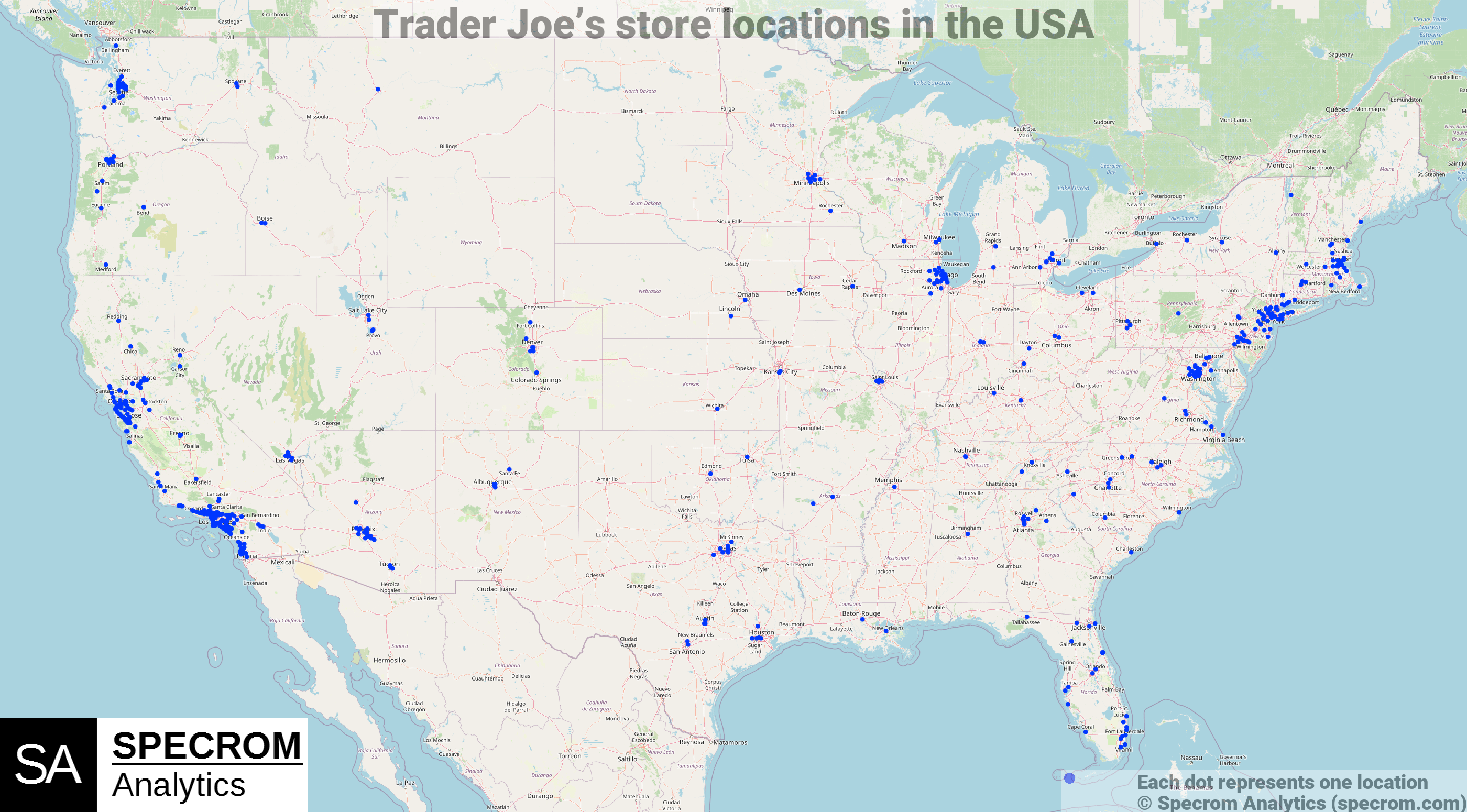 Trader Joe's store locations in the USA — View dataset & download CSV
Convenience stores carry a limited selection of staples and other convenience goods. They are typically located near busy roads, residential areas, or alongside gas stations, and operate extended hours (often 24/7). The average convenience store is around 2,400 square feet and follows a diagonal or straight store layout optimized for quick trips.
There are over 150,000 convenience stores in the United States, making them the most numerous type of retail outlet by count. They charge higher prices than supermarkets due to smaller purchase volumes and the premium of convenience. Major chains include 7-Eleven (the largest globally), Wawa, Sheetz, QuikTrip, and Casey's General Stores. Many also have a fuel station as part of their operations.
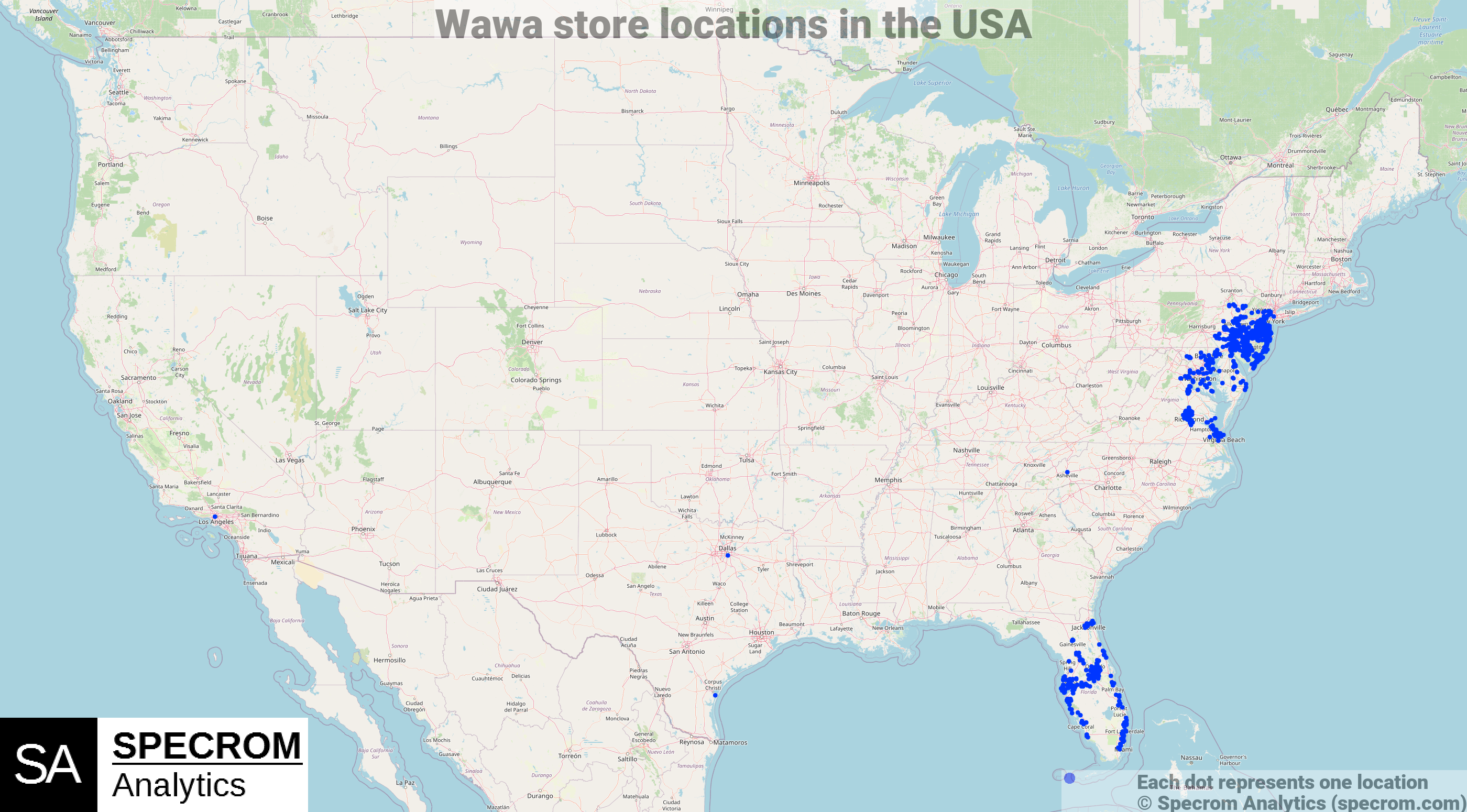 Wawa store locations in the USA — View dataset & download CSV
A prescription-based drug store that generates 20% or more of its total sales from consumables, general merchandise, and seasonal items. While anchored by their pharmacy departments, modern drug stores have expanded into health and beauty, snacks, household goods, and even fresh food.
This channel includes major chain drug stores such as Walgreens (over 8,600 US locations), CVS (over 9,000 US locations), and Rite Aid. Internationally, key players include DM (Germany), Boots (UK), and AS Watson (Asia). CVS has been pivoting toward healthcare services, adding MinuteClinic locations and HealthHUB stores that offer expanded medical services.
A membership retail/wholesale hybrid with a varied selection and limited variety of products presented in a warehouse-type environment. These approximately 100,000–150,000 square-foot stores typically have 60–70% general merchandise and health/beauty products alongside a grocery line dedicated to large sizes and bulk sales.
Memberships include both business accounts and consumer groups. The three dominant US players are Costco (over 600 US warehouses), Sam's Club (around 600 locations, owned by Walmart), and BJ's Wholesale Club (approximately 240 locations concentrated in the Eastern US). The warehouse club model generates revenue from both membership fees and product margins, allowing them to offer some of the lowest per-unit prices in retail.
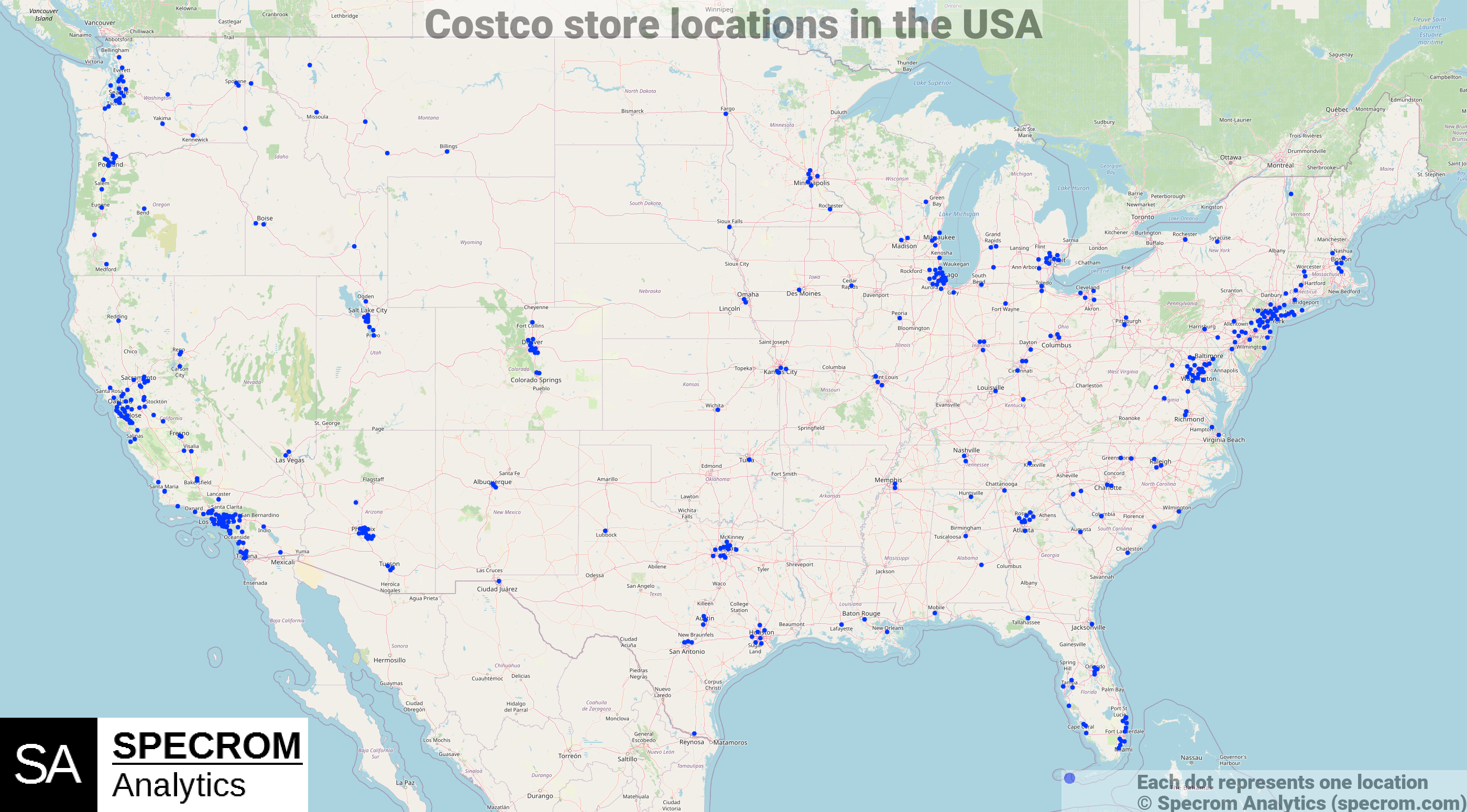 Costco store locations in the USA — View dataset & download CSV
A hypermarket is a type of retail store that combines a department store and a grocery supermarket under one roof. Often a very large establishment, hypermarkets offer a wide variety of products such as appliances, clothing, and groceries. Americans commonly refer to these as supercenters or superstores.
Merchandise includes perishables, household items, hardware, toys, small electronics, clothing, toiletries, cosmetics, furnishings, and furniture. The average Walmart Supercenter has 178,000 sq ft while a typical Carrefour hypermarket covers 110,000 sq ft. Most European and Asian hypermarkets are smaller at 30,000–50,000 sq ft.
We can trace the supercenter concept to Fred Meyer stores (now part of Kroger) that opened in Portland, Oregon in 1931. Meijer opened the first modern supercenter in Grand Rapids, Michigan in the 1960s. This concept was quickly adopted by Walmart, Target, and other discount chains, and now supercenters are among the most common retail formats in America.
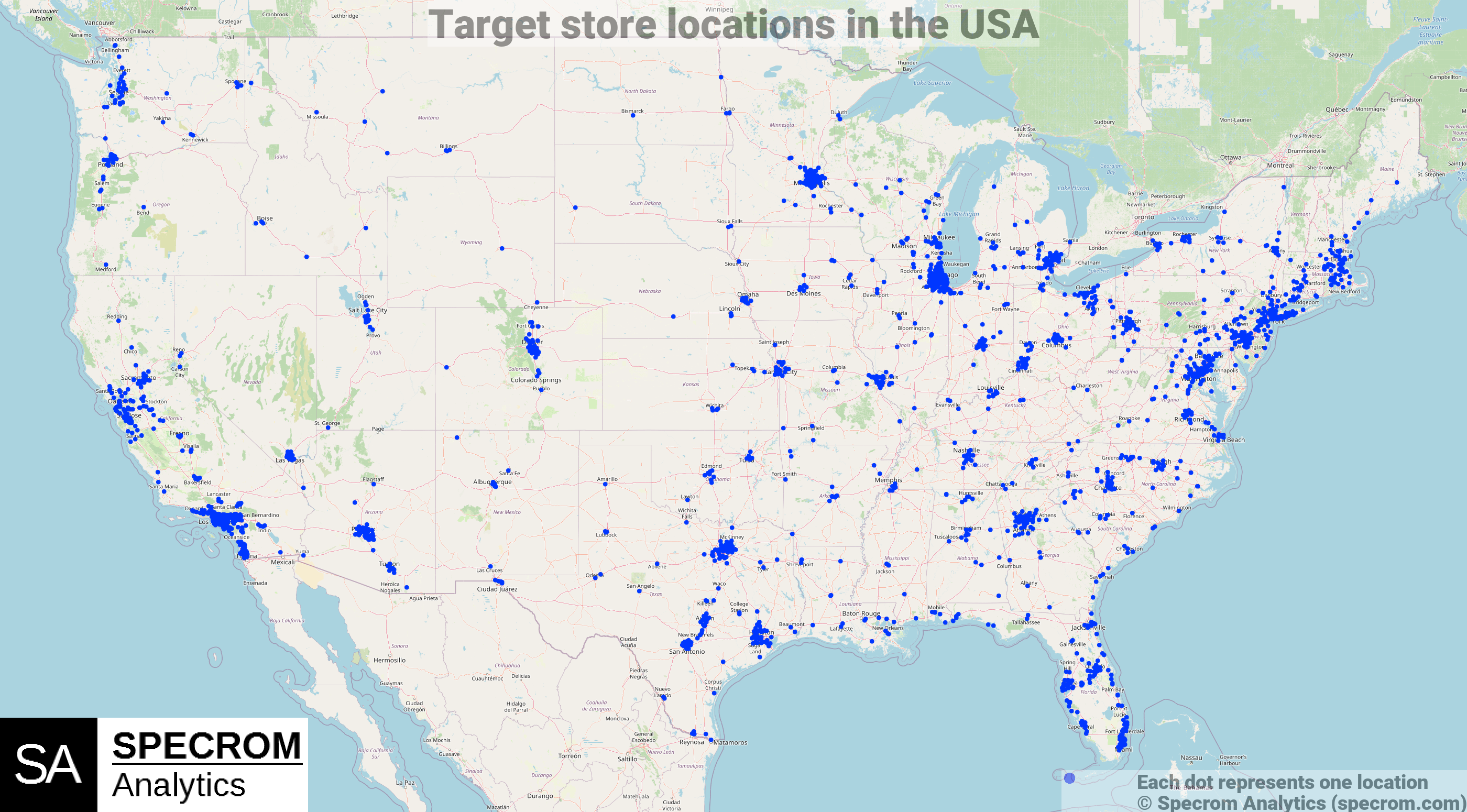 Target store locations in the USA — View dataset & download CSV
Discount stores sell local or regional brands at lower-than-market price points. They can carry a wide mix of goods or concentrate on specific merchandise types. More often than not, they buy season-end merchandise, job lots, and secondary brands.
Target, Walmart, and Kmart all started out as discount stores but transformed into the hypermarket/supercenter format we see today. The best current examples of true discount/off-price stores are TJ Maxx, Marshalls, Ross Dress for Less, and Burlington. These stores use an everyday-low-pricing model where prices remain constantly low, rather than relying on sales events.
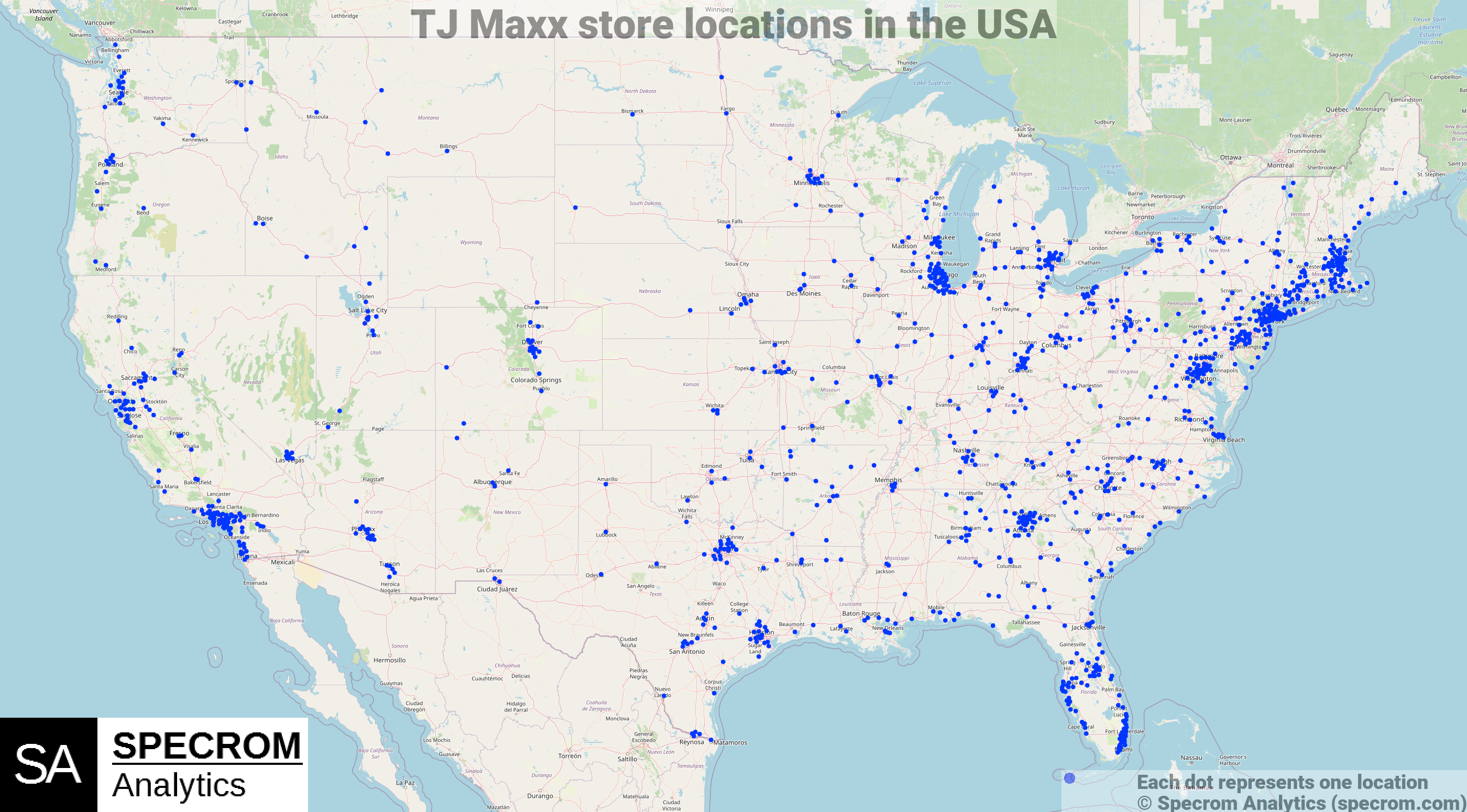 TJ Maxx store locations in the USA — View dataset & download CSV
Merchants at discount stores hunt for deals regionally and buy in bulk to get the lowest price possible. Factory outlets, developed by brand owners to release their own discounted season-end goods, are a related sub-format that gives brands control of their retail price while clearing inventory.
A subcategory of discount stores are liquidation stores that buy merchandise at very low cost from liquidation sales and pass on the price benefit to consumers. Examples include Big Lots and Ollie's Bargain Outlet.
Department stores come in two types: those with a full-line designation, which carry a wide range of merchandise from health and beauty to fashion, accessories, household items, and occasionally specialty foods; or those dedicated to specific brands or product categories. Examples of US department stores include Macy's, Nordstrom, Dillard's, Kohl's, and Belk.
Because the department store serves as "the umbrella" for a wide assortment of goods, it is convenient for customers to shop there. However, the vulnerability of today's department stores is that they have a hard time competing with true branded stores and online-only retailers. Traditional department stores have been in steep decline in the US for over a decade, with chains like JCPenney going through bankruptcy and Sears nearly disappearing entirely.
To maintain customer loyalty, many department stores have adopted store credit cards, created special card-member events, and embraced the shop-in-shop format — hosting branded sections like Sephora inside Kohl's to drive traffic. The balancing act is to not overuse such promotional tactics, which can erode perceived value.
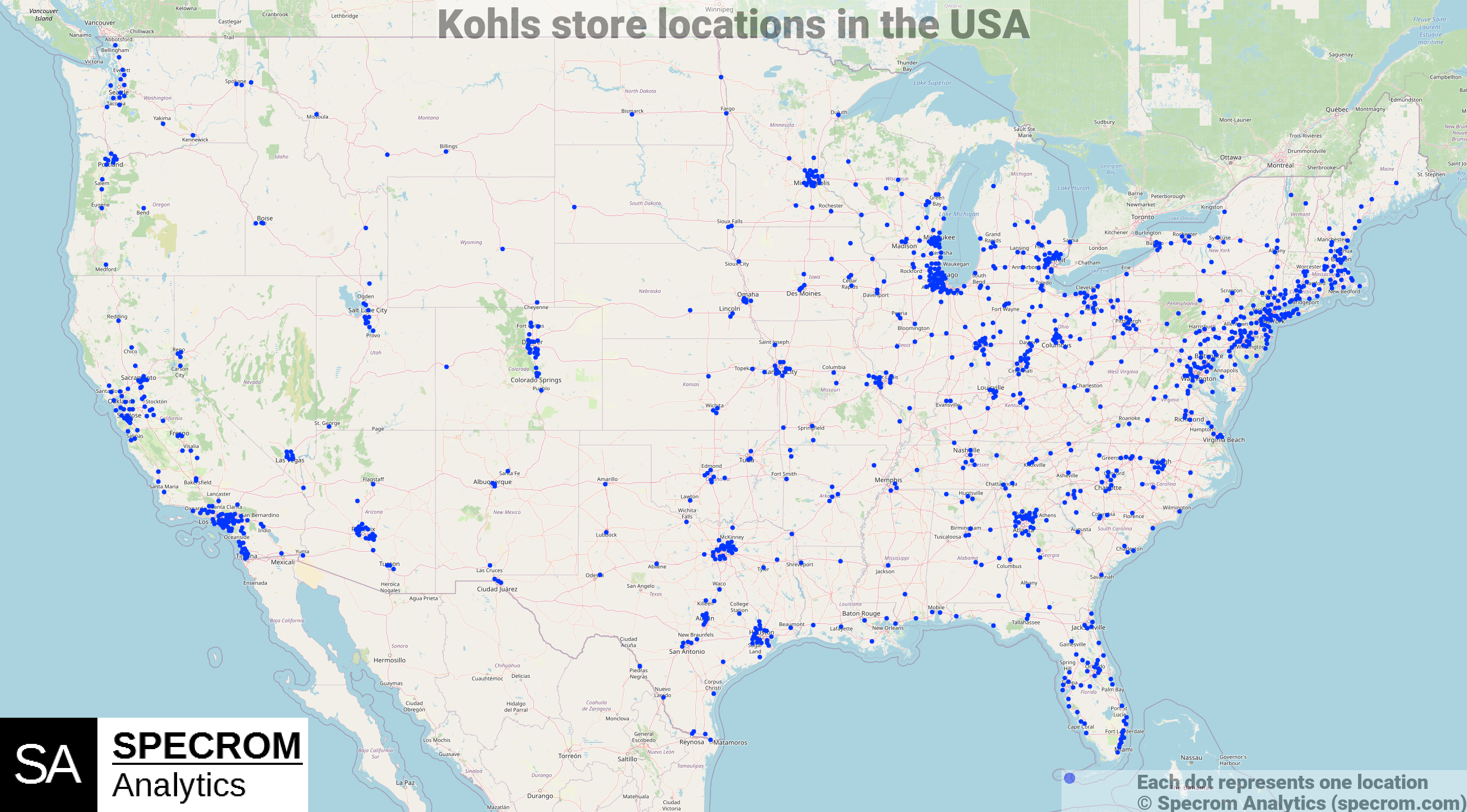 Kohl's store locations in the USA — View dataset & download CSV
Branded stores carry products from a single known brand. These may be globally renowned names like Nike, Adidas, Zara, H&M, Timberland, and Levi's; or luxury brands such as Gucci, Prada, Louis Vuitton, and Burberry.
These stores are either operated directly by the brand owners or through franchise agreements. The merchandise, price points, store layout, design, and merchandise displays are usually strictly controlled by the brand or its master licensee. Customer service is typically high and specialized.
Branded stores are usually located in premium areas — flagship shopping streets, upscale malls, or destination retail districts — with store design specifically crafted to encapsulate the mood and identity of the brand. Customer loyalty in this format is driven by brand affinity. Branded stores can lose their customer base when the brand itself loses relevance or fails to keep up with changing consumer tastes.
When the owners or developers of a retail concept wish to expand into other territories, they often adopt the franchising business model. For a fee, the franchisee is given the right to operate the retail concept in specific locations and regions, under rules and regulations set by the franchisor.
Franchising is almost a norm in the fast-food industry — McDonald's, Wendy's, KFC, Popeyes, Chick-fil-A, and Subway are all primarily franchise-operated. The model is also found in fitness (Planet Fitness, Orangetheory), services (UPS Store, Great Clips), and fashion — though in fashion, franchising is more commonly used for international expansion rather than domestic growth. For example, Gap and Old Navy operate most US stores as corporate-owned locations but use franchise agreements to expand into international markets across Asia, the Middle East, and Latin America.
The franchisor provides assistance with site selection, store build-out, product development, management training, and advertising. In return, the franchisee pays a lump-sum startup fee plus ongoing royalties on sales. For more on this topic, see our guides on what is a franchise, why buy a franchise, and choosing the right franchise location.
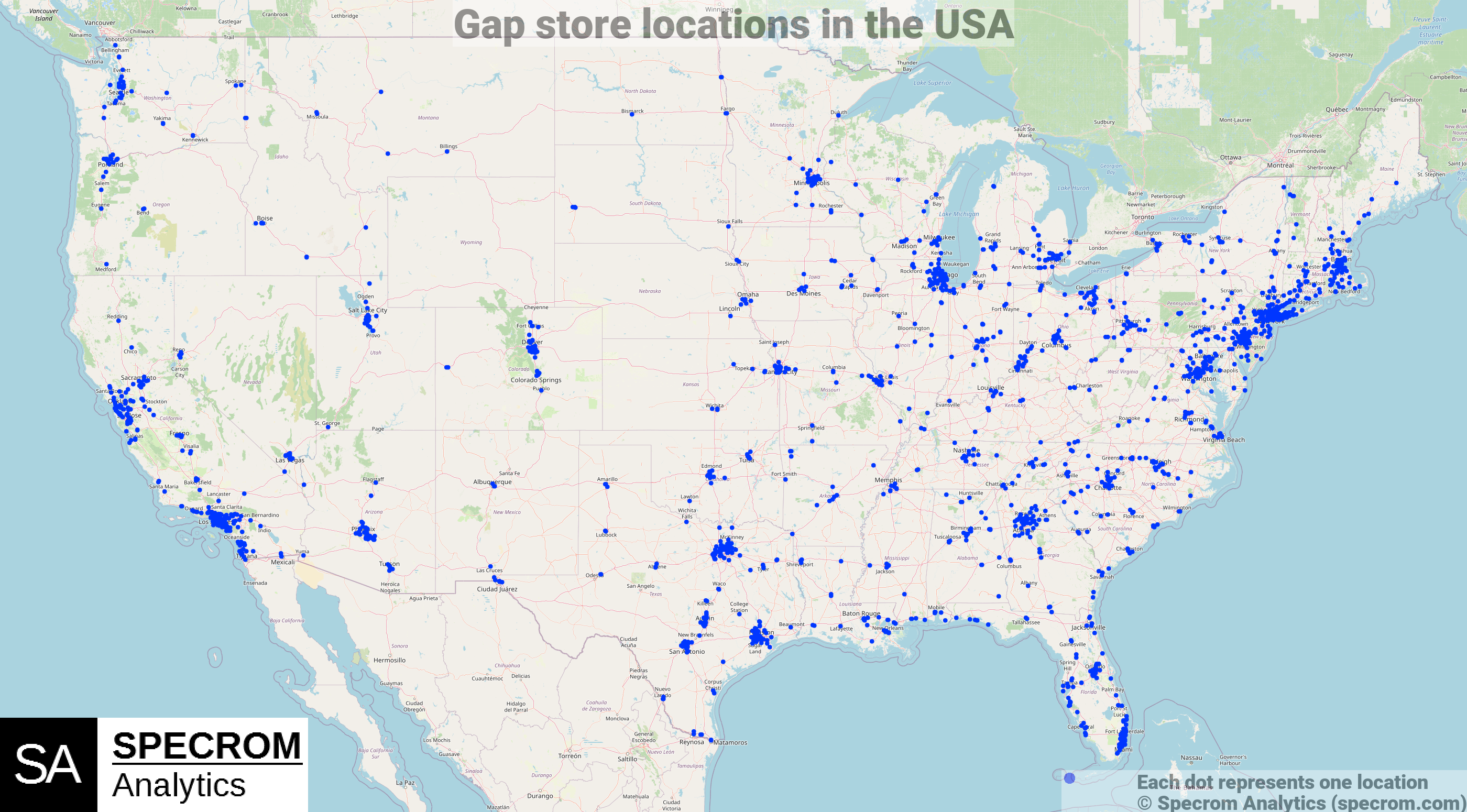 Gap store locations in the USA — View dataset & download CSV
Licensing is similar to franchising, with the main difference being the startup fee structure and operational model. Some of the best-known licensing arrangements include Benetton (the largest retail licenser in the world), Ralph Lauren, and Marks & Spencer.
Licensees are required to follow the merchandising philosophies established by the licensor. The merchandise is either produced entirely by the licensee (requiring product development capability) or purchased directly from the licensor for distribution to retail units.
Increasingly, licensors adopt a "push model" where the licensee provides an open-to-buy (OTB) budget, and the licensor selects all merchandise. While convenient for the licensor, this is riskier for the licensee as they have less control over which products end up in their stores. Ideally, licensees retain some say in their assortments to match their specific customer profile.
Specialty stores focus on specific types of merchandise with a specific lifestyle offering. They can range from luxury goods to mid-priced, high-quality goods. Customers shop these stores as a destination trip, expecting a wide choice within the specialist category and knowledgeable staff.
Common subcategories of specialty stores include:
Specialty stores are sometimes called "category killers" when they dominate their niche so thoroughly that they effectively kill off competition from general merchandisers in that category — Home Depot in home improvement and Best Buy in consumer electronics are classic examples.
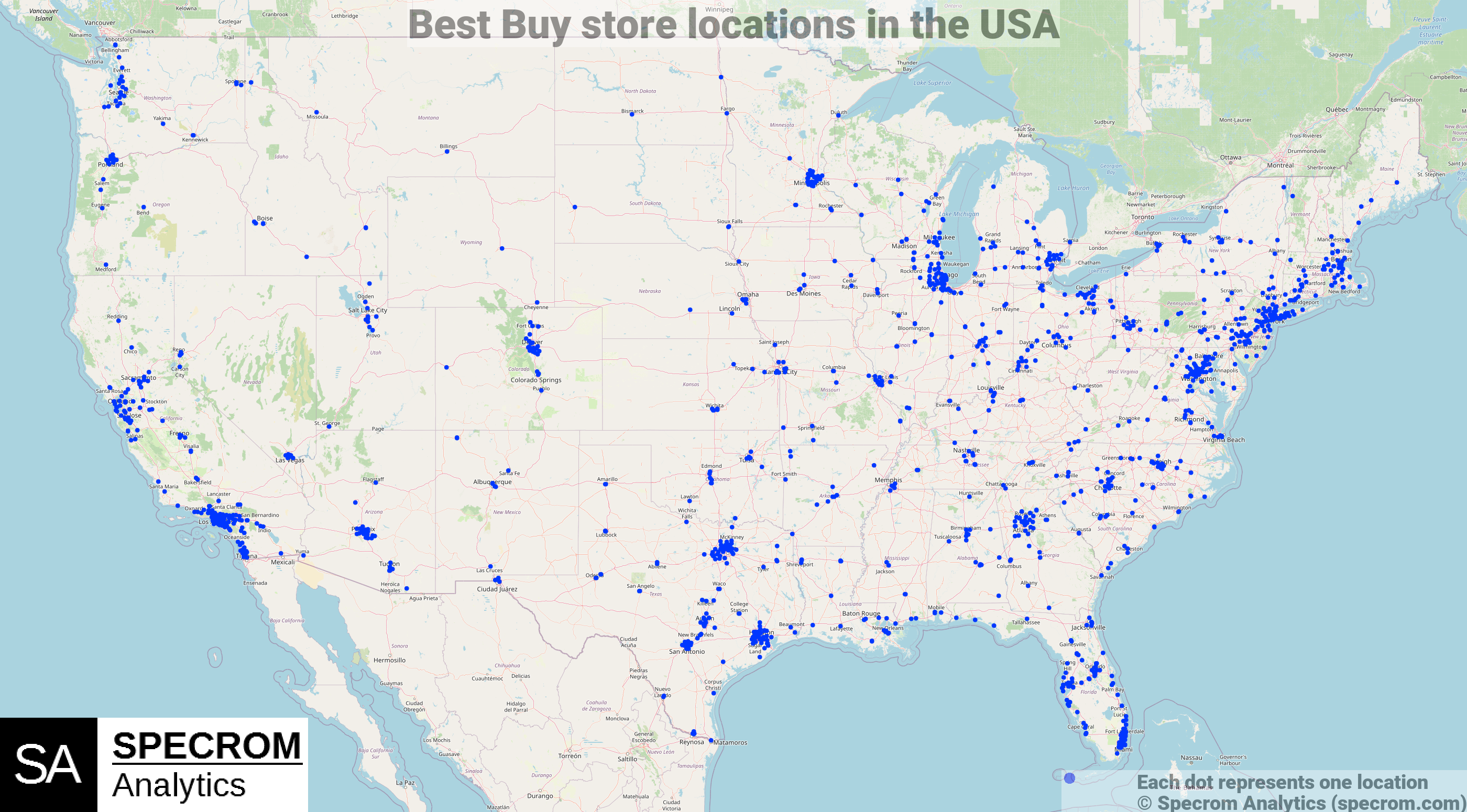 Best Buy store locations in the USA — View dataset & download CSV
The best examples of variety stores today are Dollar General (over 19,000 US locations), Dollar Tree (including former Family Dollar stores), and Five Below. These stores have seen explosive growth in recent years.
Dollar General and Family Dollar have penetrated deep into rural America and low-income urban neighborhoods, filling a need in communities with limited access to traditional big-box retailers. While some critics have raised concerns about these chains contributing to food deserts, they serve real demand in communities underserved by larger retailers.
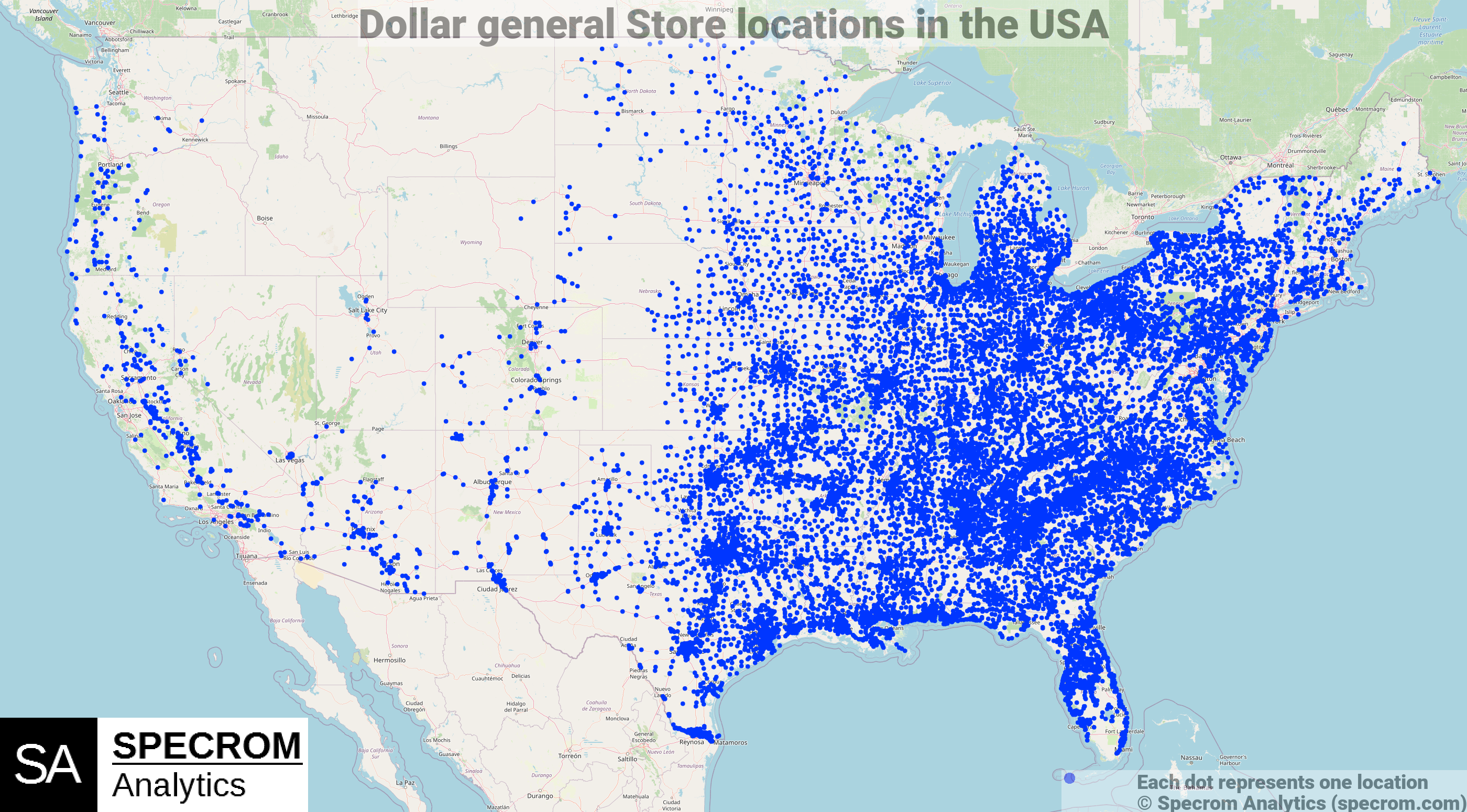 Dollar General store locations in the USA
However, not all variety stores target budget-conscious shoppers. Five Below specifically targets impulse shoppers — teens and tweens — with an in-store experience featuring loud music and merchandise priced at $5 or below (with a "Five Beyond" section for items up to $25). This differentiated approach has fueled their growth to over 1,500 stores.
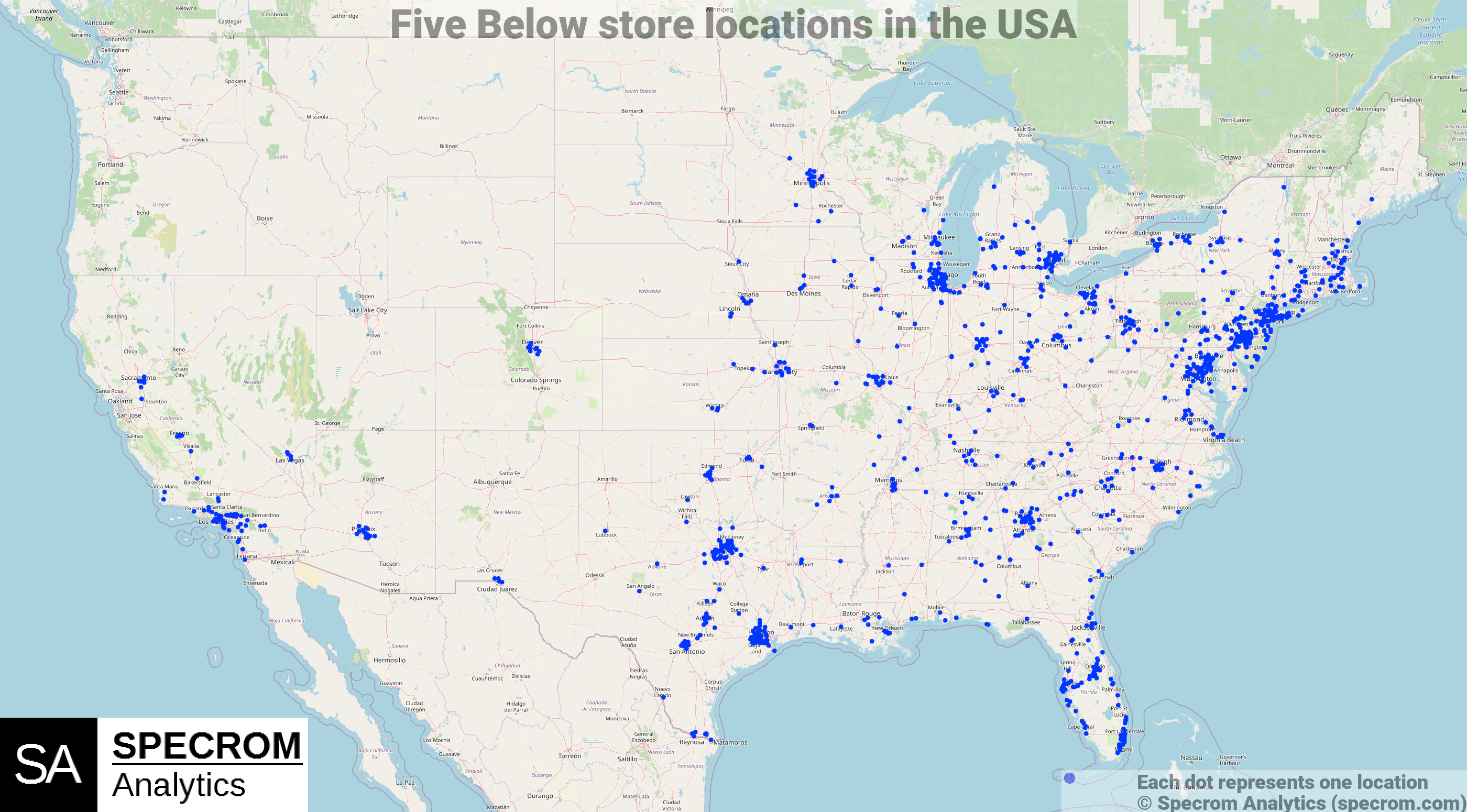 Five Below store locations in the USA — View dataset & download CSV
Independent retail is still big business. The US Census Bureau reports that over 94% of retail companies operate from a single location. Many of these stores thrive because they cater very specifically to their customers' needs and offer personalized services that chain stores cannot replicate.
The merchandise is usually limited in breadth but carefully curated. Independent "boutiques" may carry ranges of shoes, jewelry, or apparel that are typically higher priced and sometimes custom-made. Initially, owners act as their own buyers, but as the business grows, they may hire professional buyers.
The resurgence of "shop local" movements and consumer preference for unique, non-mass-produced goods has given independent retailers a significant tailwind. Many have also adopted ecommerce to extend their reach beyond their physical neighborhood. A great example is Birmingham, Alabama's Shaia's, an iconic independent store recognized by Architectural Digest as one of America's most beautiful independent shops.
The retail landscape continues to evolve. Beyond the traditional store formats described above, several newer formats are reshaping how consumers shop and how brands reach customers.
Pop-up stores are temporary retail spaces that brands occupy for anywhere from a few days to several months. They are an excellent way to test new markets, generate buzz, and create urgency. Pop-ups have become easier to execute thanks to real-estate platforms like Appear Here and Storefront that match brands with short-term spaces. Many direct-to-consumer (DTC) brands — like Warby Parker and Allbirds — used pop-ups to test physical retail before committing to permanent locations.
Experiential stores prioritize brand engagement and immersive experiences over pure product sales. Samsung 837 in New York, Niketown stores, and Apple's flagship locations are prime examples. These stores are typically located in major cities and serve as brand temples that reinforce identity and generate social media content. The goal is not necessarily to maximize per-square-foot sales but to deepen brand loyalty.
The shop-in-shop format involves a specialty brand opening a branded section inside a larger department or big-box store. This gives the host retailer differentiated product offerings while giving the specialty brand access to the host's foot traffic. A notable example is Sephora inside Kohl's, which launched in 2021 and has been shown to increase foot traffic to both brands. Other examples include Apple sections inside Best Buy and Disney shops inside Target.
Dark stores are retail locations that are closed to the public and used exclusively for fulfilling online orders. During and after the pandemic, many retailers converted underperforming stores into dark stores to speed up ecommerce delivery. Grocery delivery services like Gopuff and Gorillas pioneered micro-fulfillment centers in urban areas, though many have since scaled back.
Grocerants blend grocery retail with restaurant-style dining. The most prominent example is Eataly, a chain that celebrates Italian cuisine by combining a market, restaurant, and cooking school under one roof. Many traditional supermarkets have also added prepared food counters, seating areas, and in-store cafés to capture more of the food-service dollar.
Retail stores can be categorized along several dimensions. Understanding these classification axes is essential for anyone studying retail categories, doing market research, or positioning a new retail concept.
Independent (single-owner), chain (multiple units under one company), franchise (licensed to independent operators), and cooperatives (retailer-owned buying groups like Ace Hardware or IGA).
Food retailers (supermarkets, grocery), softline retailers (apparel, footwear), hardline retailers (electronics, hardware, furniture), and mixed merchandise (department stores, hypermarkets).
Everyday low pricing (EDLP — Walmart, Aldi), high-low pricing (regular prices with frequent sales — Macy's, Kohl's), premium/luxury (Nordstrom, Gucci), and off-price/discount (TJ Maxx, Ross).
Small format (<5,000 sq ft — convenience stores, boutiques), mid format (5,000–40,000 sq ft — drug stores, specialty), large format (40,000–100,000 sq ft — supermarkets), and big box (>100,000 sq ft — hypermarkets, warehouse clubs).
Store-based (physical locations), non-store (ecommerce, catalog, direct selling, vending machines), and omnichannel (integrated physical + digital operations with BOPIS, same-day delivery, etc.).
High street / downtown, shopping mall, strip mall, standalone / freestanding, airport / transit hub, and outlet center.
This is one of the most commonly searched retail distinctions. Here's a clear breakdown of how these two retail models differ.
| Dimension | General Merchandise (Department Stores) | Discount Retailers |
|---|---|---|
| Pricing strategy | Standard retail prices with periodic sales events and promotions | Everyday low prices, consistently below market rate |
| Merchandise sourcing | Direct from brands at wholesale prices, current-season inventory | Overstock, season-end, job lots, secondary brands |
| Product range | Wide and deep — many categories and brands | Wide but shallow — many categories, limited predictable selection |
| Store experience | Curated displays, customer service, fitting rooms | Self-service, "treasure hunt" shopping, minimal frills |
| Brand positioning | Mid-range to premium | Value-oriented |
| US examples | Macy's, Nordstrom, Kohl's, Dillard's | TJ Maxx, Ross, Marshalls, Burlington |
The major difference is that supercenters and general merchandise retailers tend to have higher mean prices but use promotional tools more often and more widely. Hypermarkets use promotional areas with strong signage that creates the impression of lower prices. The advantage supercenters have is in the depth and width of products on offer, which makes it practical for consumers to do all their shopping in one place.
Specrom Analytics provides geocoded store location datasets for 500+ retail chains across the USA and internationally. Each dataset includes addresses, GPS coordinates, phone numbers, and more — delivered as a clean CSV file.
Tell us which retail chain you need data for and we'll send you a quote. Pricing starts at $50.
The main types of retail store formats are: supermarkets/grocery stores, convenience stores, hypermarkets/supercenters, department stores, discount stores, specialty stores, warehouse/wholesale clubs, drug stores, branded stores, franchise stores, license stores, variety/dollar stores, mom-and-pop independent stores, ecommerce stores, pop-up stores, factory outlet stores, and off-price retailers. Each format differs in size, product range, pricing strategy, and target customer.
A supermarket primarily sells food, beverages, and household products in a store typically around 40,000–50,000 sq ft. A hypermarket (also called a supercenter) combines a full supermarket with a department store under one roof, typically spanning 100,000–200,000 sq ft, and sells groceries alongside clothing, electronics, furniture, and more. Kroger and Publix are supermarkets; Walmart Supercenter and Meijer are hypermarkets.
General merchandise retailers like department stores (Macy's, Kohl's) carry wide assortments at standard retail prices with an emphasis on brands and customer service. Discount stores (TJ Maxx, Ross, Marshalls) sell similar categories but at lower prices by purchasing overstock and season-end merchandise. Discount stores use everyday low pricing, while general merchandise retailers rely more on periodic sales events.
Convenience stores and gas stations are the most numerous retail format in the US, with over 150,000 locations. Dollar General alone operates over 19,000 stores, making it one of the largest chains by store count. There are approximately 63,000 grocery stores and supermarkets, followed by tens of thousands of specialty stores.
A retail store format is a classification system used to categorize retail businesses based on factors like store size, product assortment, pricing strategy, ownership model, and target customer. Understanding retail formats helps businesses position themselves in the market and helps consumers know what to expect from different types of stores.
Emerging retail formats include pop-up stores (temporary retail spaces), experiential stores (focused on brand engagement), shop-in-shops (branded sections within larger retailers, like Sephora inside Kohl's), dark stores (fulfillment-only locations for online orders), grocerants (hybrid grocery-restaurant concepts like Eataly), and showroom stores. These formats reflect the evolving relationship between physical and digital retail.
Specrom Analytics provides geocoded store location datasets for 500+ retail chains across the USA and internationally. Each dataset includes addresses, GPS coordinates, phone numbers, and more. Datasets start at $50 and are delivered as CSV files. You can browse existing datasets or request a custom dataset for any retail chain.
A practical guide for brands looking to get their products into retail stores.
Top strategies for getting your products into major US retail chains.
A glossary of retail performance metrics, math, and industry nomenclature.
Understanding the franchise business model in retail and food service.