Most reviews are five stars. That's not news to anyone who hosts. But the small slice that isn't, 683 reviews across the Smokies, North Georgia, Asheville, Western North Carolina, and the surrounding lake markets, is where almost everything worth knowing actually lives: what breaks, what gets oversold, what guests will forgive, and what they won't. We read all 683 in full, along with every host reply attached to them, and sorted out what's actually driving the rating down and how hosts respond when it happens.
Two things came out of it. First, a ranked, real picture of what actually tanks a review in this market, and it's not what most punch lists prioritize. Second, and this is the part that matters most: a look at how hosts reply to a bad review, and a clear, repeatable answer for when to apologize, when to explain, when a short correction is fair game, and when a reply does more damage than the review it was meant to fix.
What's actually costing you stars
Ranked by how often each issue shows up in a sub-4-star review (a review often raises more than one thing, so this doesn't add to 100%):
Why Guests Leave a Sub-4-Star Review
Share of the 683 low-star reviews mentioning each issue. A review can raise more than one, so the bars don't add to 100%.
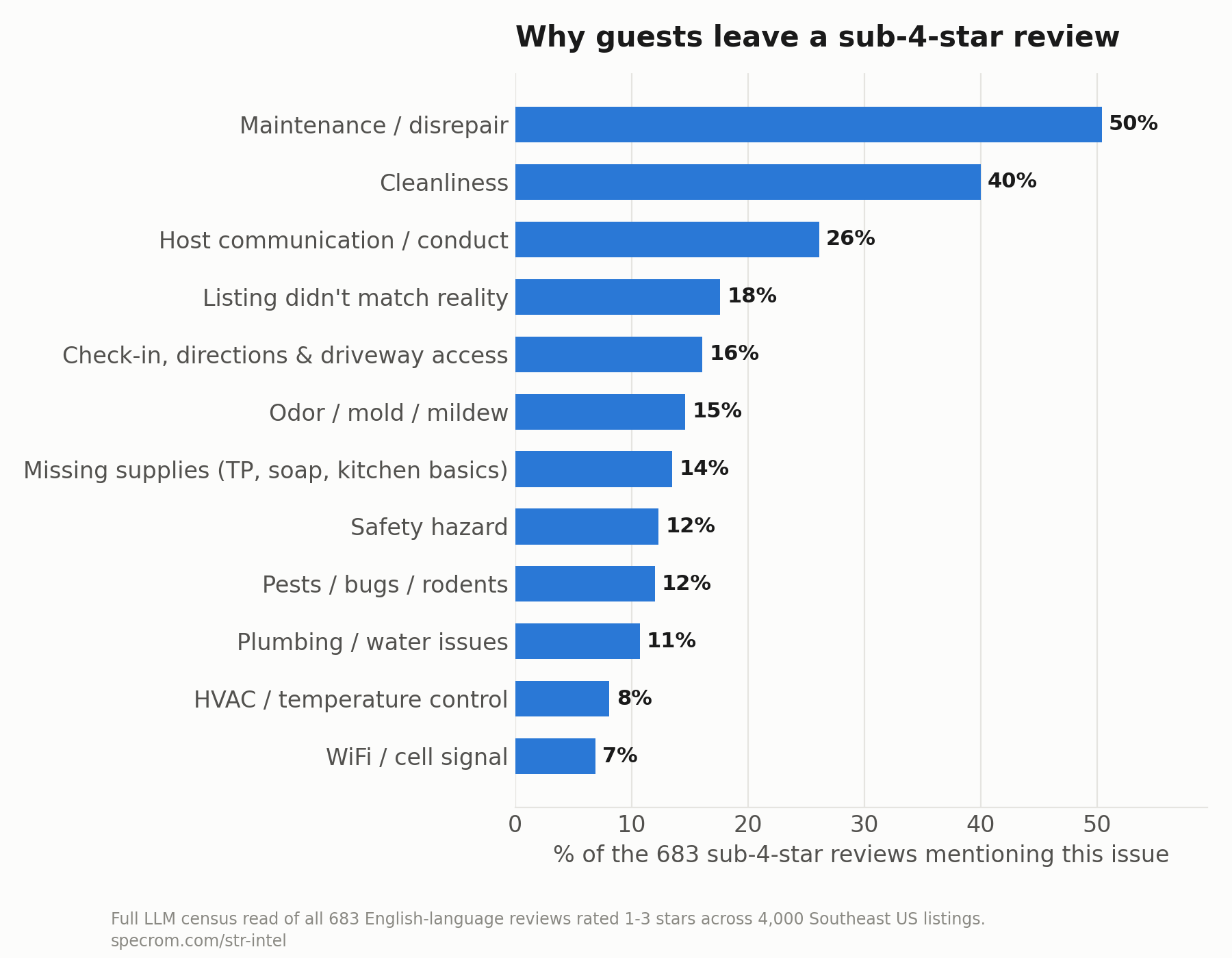
Maintenance is the single biggest reason, showing up in half of all bad reviews. A dishwasher that won't run, a recliner that won't recline, a pool table with a chipped rail: it's rarely the only thing wrong in a bad review, but it's almost always part of the pile-on.
Cleanliness is close behind at 40%, and it's the complaint guests describe in the most detail: hair in a shower, a dirty hot tub filter, stains on a couch cushion. It also tends to set the tone for the whole review: a dirty first impression at check-in colors everything a guest writes after it.
Host communication and conduct sits at 26%, and it's the one that does the most damage. More on that below, but the short version: this is the complaint that shows up hardest in your worst reviews specifically, and it's the one item on this list that has nothing to do with the cabin and everything to do with how you (or your PM) handled it when something went wrong.
After that: the listing didn't match what was booked (18%: old photos, an amenity that's overstated, a "hot tub view" that's actually a neighbor's driveway); check-in and driveway access (16%: a steep gravel drive that needed 4WD but didn't say so, wrong lockbox codes, GPS sending guests to the wrong house); odor and mold (15%); missing basics like toilet paper and dish soap (14%); safety issues (12%: exposed wiring, a broken deck rail, a nail popping through a stair tread); pests (12%); plumbing (11%); HVAC (8%); WiFi (7%).
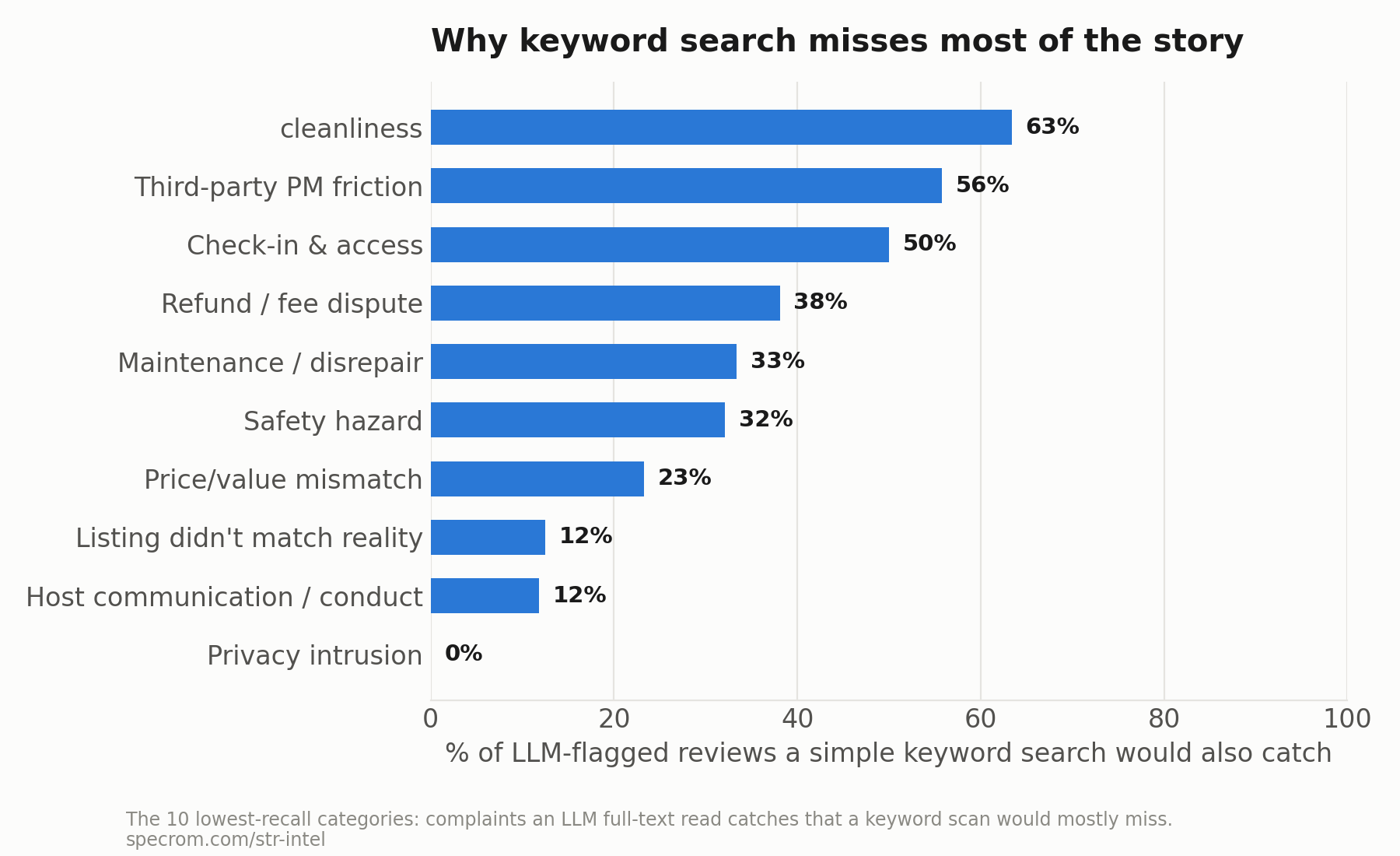
If you've ever tried to Ctrl+F your own reviews for words like "dirty" or "broken" to get a quick read on what's wrong, here's the catch: most of what actually drives a bad review doesn't use an obvious keyword at all. Guests don't write "unresponsive host." They write three paragraphs about calling four numbers on Christmas morning and never hearing back. A keyword search misses that almost entirely; reading the actual review doesn't.
What a Keyword Search Would Have Missed
For each complaint type, the share of LLM-flagged reviews a simple keyword search would also have caught.
A 1-star review and a 3-star review are angry about different things
This is the one that should actually change how you triage your punch list.
1-Star and 3-Star Reviews Are Angry About Different Things
Share of reviews at each star level mentioning each issue. Host communication and safety hazards concentrate hard at 1 star; cleanliness and maintenance stay flat across all three.
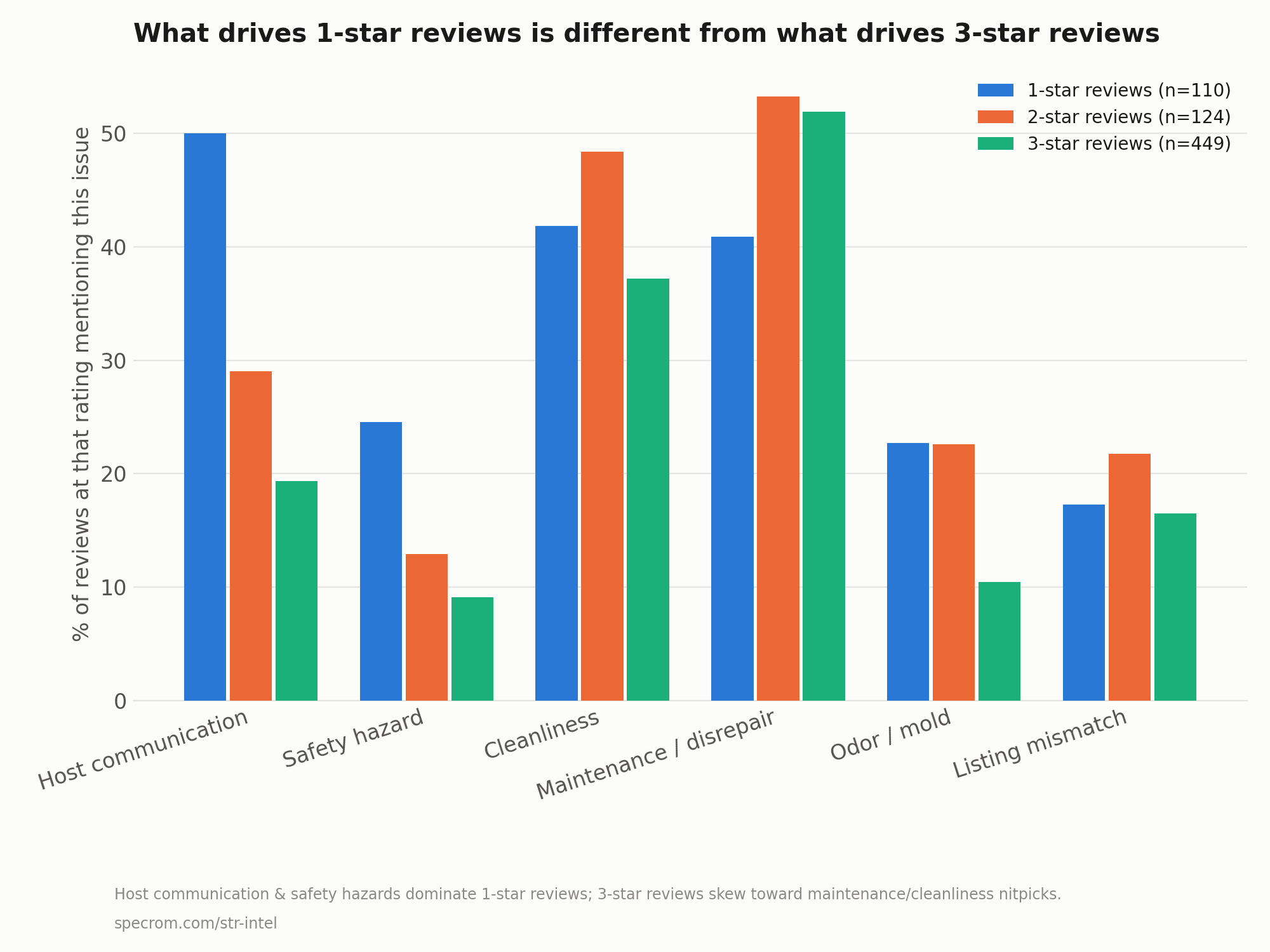
Host communication shows up in exactly half of all 1-star reviews, and only 19% of 3-star reviews. Safety issues follow the same pattern: 25% at 1-star, down to 9% at 3-star. Cleanliness and maintenance, on the other hand, barely move across the three tiers: they're the background hum of a "fine, but needs work" 3-star review just as often as they're part of a 1-star pile-on.
In plain terms: fixing the recliner and re-caulking the shower is what moves you from 3 stars to 4. Answering the phone fast, and answering it well, is what keeps you out of 1-star territory in the first place. If you're deciding where the next maintenance dollar goes versus the next hour of your own time, that's the tradeoff.
Where you operate shifts the mix, a little
The same top five issues (maintenance, cleanliness, communication, listing accuracy, pests) lead almost everywhere, but the rates shift by market in ways that track the terrain and inventory:
The Same Issues, Different Rates by Market
Blue Ridge, Ellijay, Helen, Blairsville, Hiawassee. Maintenance leads hard at 47%, cleanliness at 43%: an older cabin stock getting worked.
Gatlinburg, Pigeon Forge, Sevierville. The highest maintenance rate anywhere (62%) and the highest missing-supplies rate (18%): big-capacity party cabins turning over fast.
Bryson City, Waynesville, Maggie Valley, Murphy. Access complaints run notably higher here (24% vs. 16% overall): steep, remote driveways and dead cell zones are a real pattern.
Host communication is the highest of any market (33%), along with listing-accuracy complaints (22%): more professionally managed inventory, and guests scrutinizing it harder.
Lake Lure, Hartwell, Toxaway. Odor and mold run well above average (25% vs. 15%): waterfront humidity doing what waterfront humidity does.
None of that means one market is "worse." It means the shape of your likely failure points depends on where you operate, and that's worth knowing before you spend a maintenance budget on the wrong thing.
Half your bad reviews get zero reply
Only 51% of the sub-4-star reviews in this dataset got any host reply at all. The other half just sit there, permanently, for the next guest to read.
The Worse the Review, the More Likely a Reply
Reply rate by star rating. Hosts respond most to the worst reviews, but a large share of even those get no response at all.
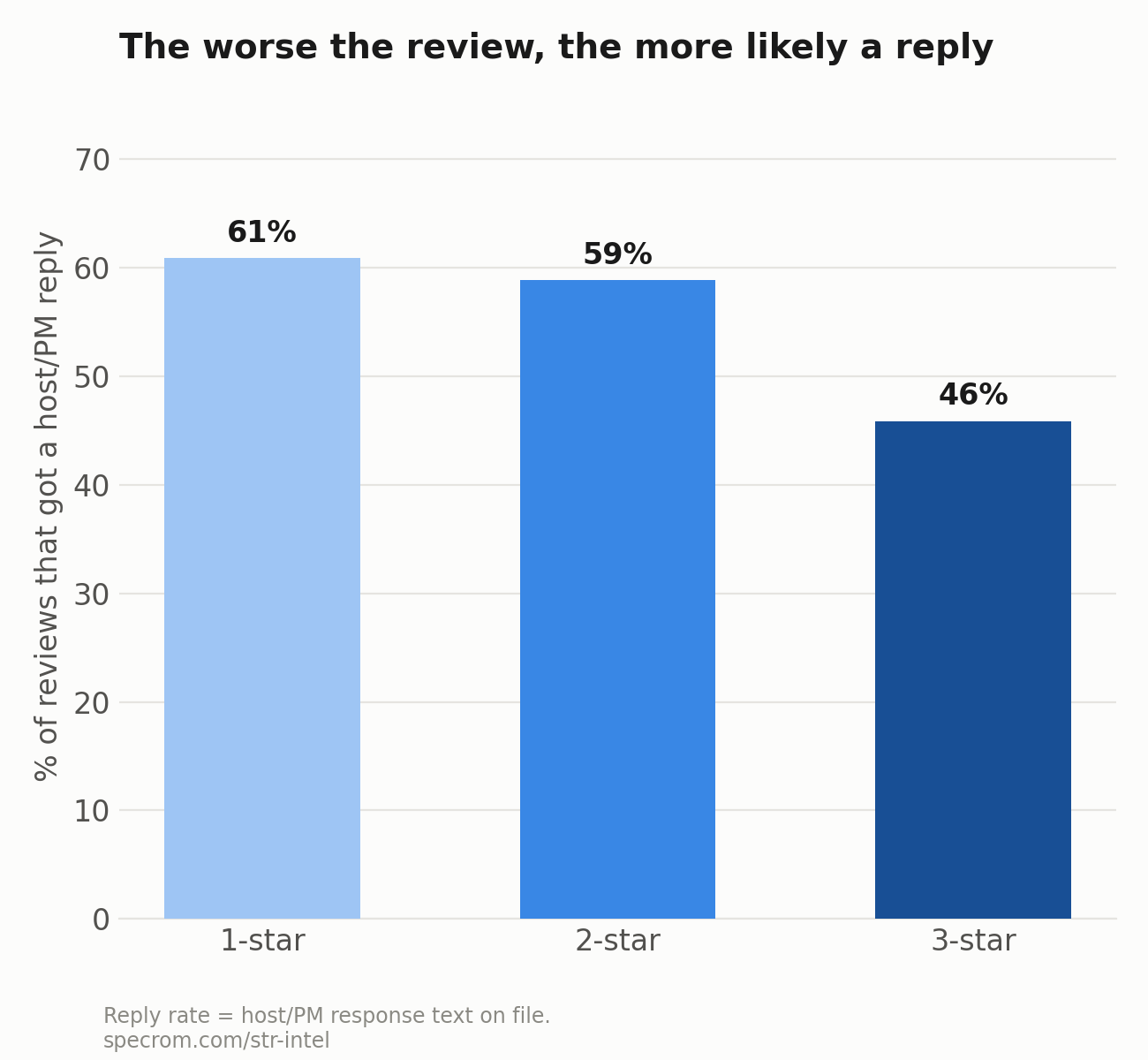
Hosts do reply more to the worst reviews (61% at 1-star, down to 46% at 3-star), which is the right instinct. But that still leaves close to 4 in 10 of the worst reviews sitting there with no response, ever, on a page every future guest will read before they book.
When hosts do reply, here's what they actually say
How Hosts Actually Respond to a Bad Review
What host replies actually do, across all 683 sub-4-star reviews. Red is no response. A reply can carry more than one strategy, so the bars don't add to 100%.
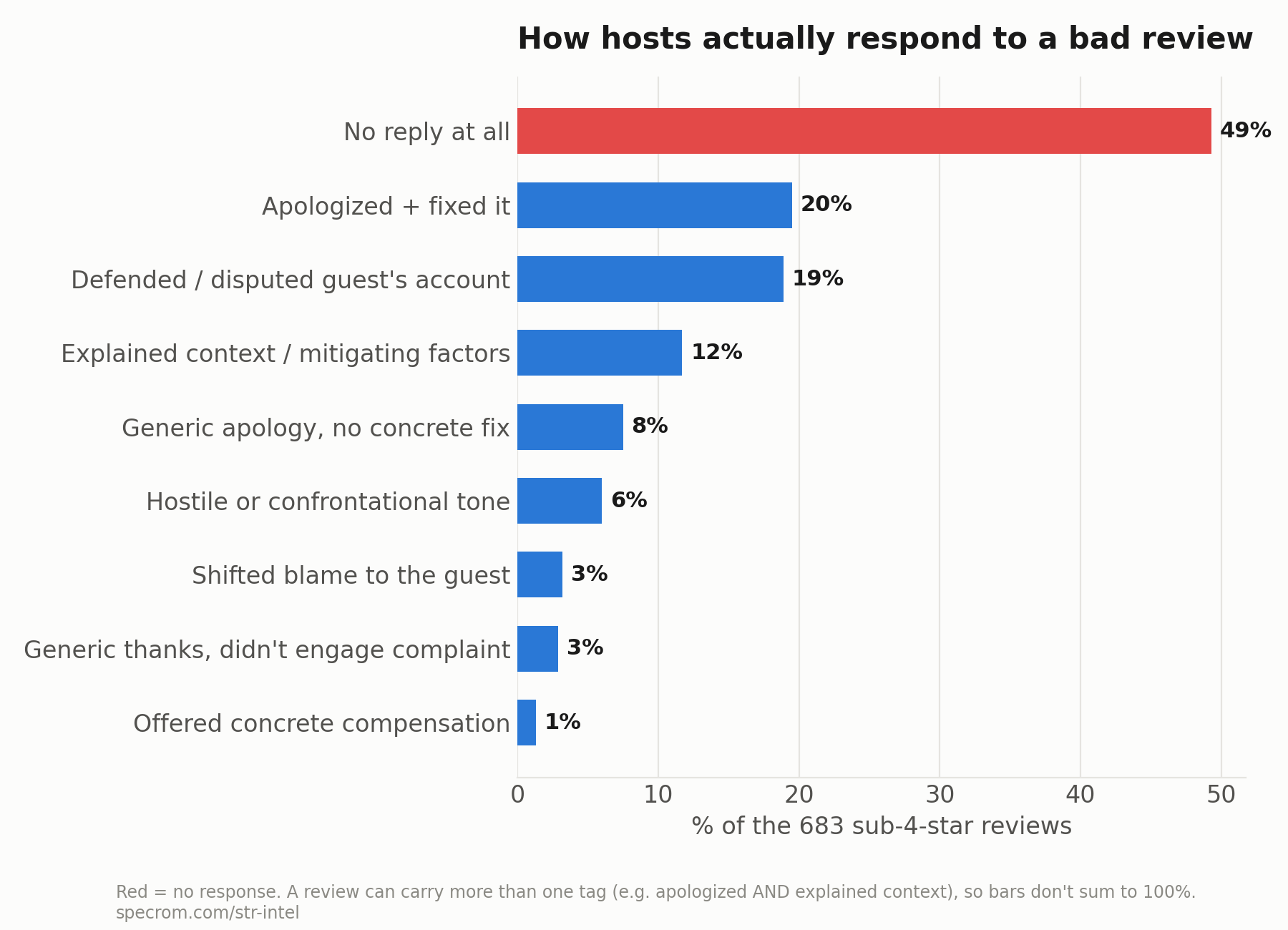
Nearly 1 in 5 bad reviews (20%) get a reply that's a real apology paired with a real fix: "we sent someone within 30 minutes," "we've replaced it and scheduled a deep clean." Almost exactly as many (19%) get the opposite: a reply that disputes the guest's account outright. Another 12% get a reply that explains context without fully apologizing or fully denying anything. Then it gets worse: 8% get a generic, no-substance "sorry," 6% get a hostile-toned reply, 3% get a reply that shifts blame straight onto the guest.
Your best hosts fight back more than your newer ones do
Your Best Hosts Fight Back More Than Your Newer Ones Do
Reply strategy mix, Superhost vs. non-Superhost. Superhosts dispute, get hostile, and blame the guest more often; non-Superhosts apologize and fix more often.
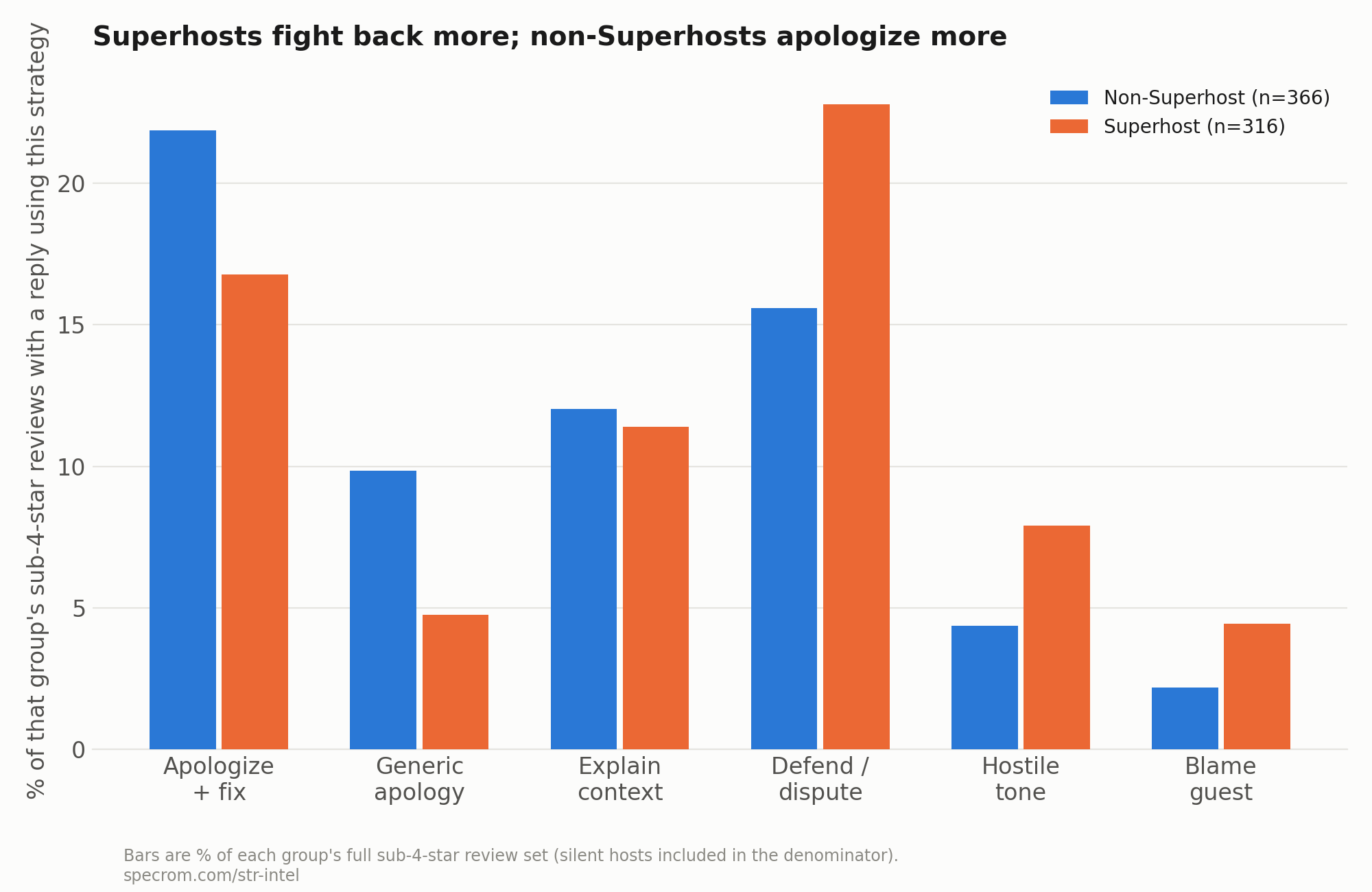
Superhosts dispute a guest's account more often than non-Superhosts (23% vs. 16%), and they're more likely to get hostile (8% vs. 4%) or blame the guest outright (4% vs. 2%). Non-Superhosts apologize and fix more often (22% vs. 17%).
That's not because Superhost status makes someone a worse communicator: it's more likely that a host with 200 great reviews behind them genuinely believes one bad one is an outlier worth fighting, while a newer host with less of a cushion takes the complaint at face value and tries to fix it. Worth noting: the properties whose hosts fight back the hardest don't actually have lower overall ratings than the ones that apologize. They're often slightly higher. That's not proof that fighting back works. It's much more likely that hosts with a genuinely strong track record feel they can afford to push back, while hosts with real recurring problems know an apology is the honest move. Either way, the instinct to defend first isn't something Superhost status protects you from; if anything, it's more common the more successful you already are.
The reply playbook
Not "always apologize," not "the customer is always right": an actual framework, built from reading hundreds of real replies and watching which ones landed and which ones made things visibly worse. One thing to keep in mind through all of it: a host reply isn't really written for the guest who already left. It's written for every future guest deciding whether to book.
1. Something's actually broken: apologize, name the fix, stop
The strongest replies in the entire dataset all do the same three things: acknowledge the specific problem, state the specific action taken, and stop. Nobody's scrolling for length. From a Blue Ridge host, after a guest reported a dirty hot tub and stale towels:
"As soon as you let us know about your concerns, our cleaning team was back at the cabin within 30 minutes. They confirmed the hot tub's water chemistry was properly balanced, but because your comfort was our top priority, we chose to completely drain, refill, and reheat the hot tub that same evening."
Or, shorter, from a Gatlinburg host after dead bugs and a broken pool heater:
"Our team has addressed the cleaning concerns, and repairs for the pool heater have already been scheduled."
Under 50 words, both times. Confirm you read it closely, name a real action (not "we'll look into it"), and stop before you start defending anything else. This is only 20% of all bad reviews, and it's the one with the clearest sign of actually rebuilding trust for whoever reads it next.
2. There's context the guest didn't have: add it once, briefly, and move on
This works when it's genuinely new information, said plainly, without three paragraphs re-litigating points the guest already conceded. A North Georgia host, after a guest flagged highway noise and no garage door opener:
"You're absolutely right about the garage door opener — we're currently down three of them and had to make the difficult decision not to leave one at the home. Each bedroom is equipped with a white noise machine to help promote a restful night's sleep."
That doesn't deny the noise or over-apologize: it just adds a fact the guest didn't have and shows a fix already in motion. Compare that to a property-managed listing responding to a guest who couldn't get a key issue resolved for two days:
"We regret that we missed the opportunity to assist you sooner. We're glad to hear you enjoyed the home overall, and we'd also like to clarify that the key you mentioned was available as outlined in the property manual, located on the pantry door."
That reply does real work: it apologizes for the delay and explains the miscommunication, without pretending the delay didn't happen. This style shows up in 12% of all bad reviews, and it reads well specifically because it doesn't try to erase the guest's frustration; it just adds the one fact they were missing.
3. The guest is flatly wrong about something checkable: correct it, narrowly, and stop
There's a right way to push back, and it's short. A Bryson City host, after a guest warned future travelers they'd need 4WD:
"This cabin does not require 4WD or AWD. It is paved all the way to the cabin, other than the parking area."
Two sentences. No adjectives, no accusation, nothing about the rest of the stay: just a correction of one checkable, forward-looking claim that matters to whoever books next. That's the whole job of a defend-style reply: protect future guests from bad information, not defend your own honor. Almost 1 in 5 bad reviews get some version of a "defend and dispute" reply. The ones that work look exactly like this. The ones that don't are next.
4. What never works: hostility, blame, and relitigating the whole stay
Some of what we read was genuinely rough. One host, after a guest described "a very busy trailer/RV park," "old furnishings with a dead animal smell," and a refused refund:
"Something is completely wrong with this lady! If any future guests read her review its completely wrong and you will love your stay like all the other guests do!"
Another, after a guest reported dirty blankets and appliances that didn't work:
"Amazing. Dirty? Absolutely not. […] It's interesting that Masoud has avoided addressing any of the issues I raised with him. […] Nine years as a host: ABSOLUTE WORST GUEST EVER!!"
Neither reply is written for the guest: it's written at them, in front of an audience. And that audience is the actual problem: every future guest now has direct proof of how this host behaves under pressure, which tells them more than the original review ever did. Hostile replies show up in 6% of the data, blame-shifting in another 3%. Small shares, but each one is a permanent, public exhibit that outlives the review it was trying to shut down.
The short version
The Decision Order
Apologize, name the fix, and stop.
Add it once, briefly. Don't relitigate the rest.
Correct that one thing, in two sentences, and stop.
The reply that feels most satisfying to write is usually the one that reads worst to the next hundred people who see it. Often the right move is the shortest possible acknowledgment, or nothing at all.
Silence reads as neutral. Hostility reads as a warning label.
Frequently asked questions
Does replying to a bad review actually help?
The reply is public and permanent, and it isn't really "for" the guest who already left: it's for everyone deciding whether to book after them. A calm, specific, fix-oriented reply is evidence you're competent under pressure. A defensive or hostile one is evidence of the opposite, regardless of who was technically right.
Is it ever better to just not reply?
Sometimes, but "no reply" is already the single most common outcome in this data (about half of all bad reviews), and it's more often neglect than strategy. If you do reply, short and specific beats long and defensive almost every time we saw it tested.
What if the guest is genuinely exaggerating or lying?
It happens. Even then, the replies that read as credible to a future guest are narrow, factual corrections, not a full point-by-point takedown of the guest's character. You're not trying to win an argument the guest can't respond to again. You're trying to leave the next hundred readers with accurate information and a good impression of how you handle a problem.
Does this hold for every market, or just certain ones?
The shape holds everywhere we looked: maintenance and cleanliness lead by volume, communication and safety issues dominate the worst reviews, and about half of bad reviews go unanswered. What shifts by market is degree, not direction.
How do I know what my own listings' complaint pattern actually looks like?
That's exactly what this piece can't tell you: it's a market-wide read, not a diagnosis of your specific listings. That's what a listing-level teardown is for.
This piece looked at your own reviews. If you'd rather start with what your comp set's guests are saying, our piece on mining competitor reviews for pricing and amenity intel covers that side of the same dataset.
We'll Sort Your Reviews Into What's Fixable, at No Cost
If you run one cabin or thirty across the Smokies, North Georgia, Asheville, or the lake markets, the odds are good that some version of this pattern is sitting in your own review history right now, you just haven't had someone sort it into what's actually fixable versus what's about how fast and how well you (or your PM) respond under pressure. That's the same read, done at the listing level, in a free teardown of your own reviews and comp set.