
A store-level look at competitive density, department-listing ratings, ethnic grocery mix, service attributes, and expansion patterns across all 1,486 mapped Publix locations in eight states.

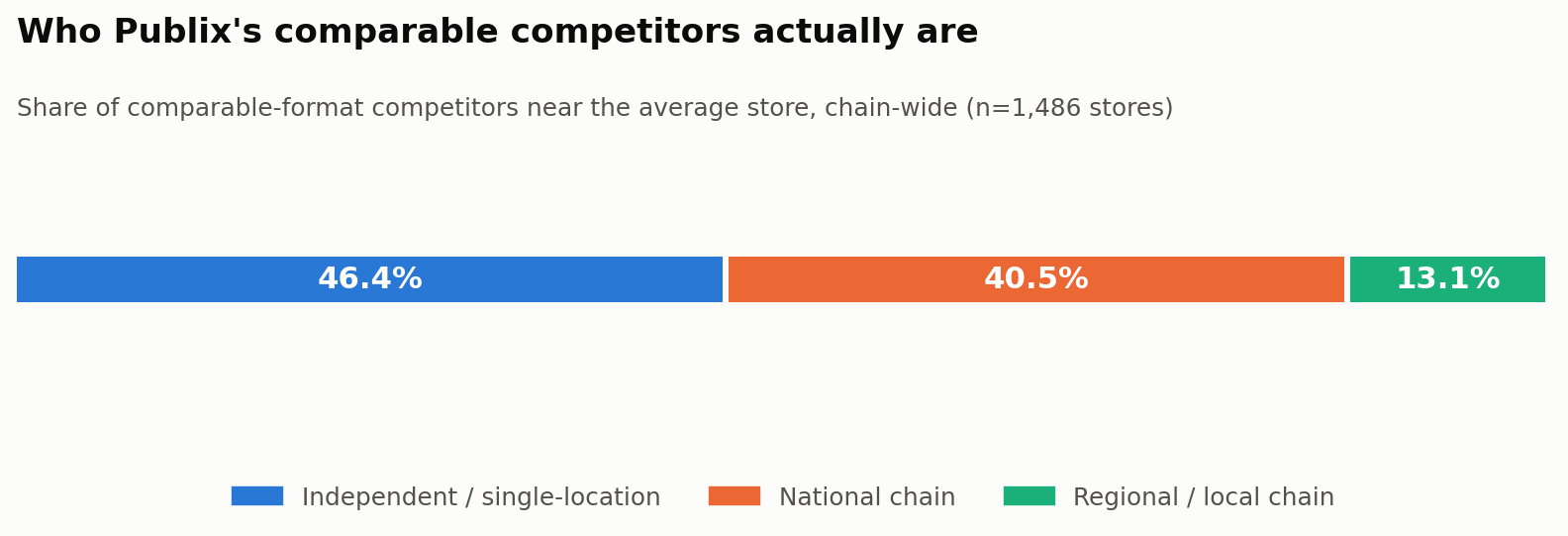 Independent grocers narrowly outnumber national chains among Publix's nearby competitors — not the "Publix vs. Kroger" story you'd expect.
The average Publix has about 13 real grocery-format competitors nearby, and the mix isn't what the usual "Publix vs. Kroger" framing suggests.
Independent, single-location grocers are Publix's single largest competitor bucket — narrowly ahead of national chains, with regional and local chains a distant third. That runs against the instinct that Publix mostly competes with Kroger, Walmart, and ALDI. It doesn't; it competes with a long tail of small, local operators just as much.
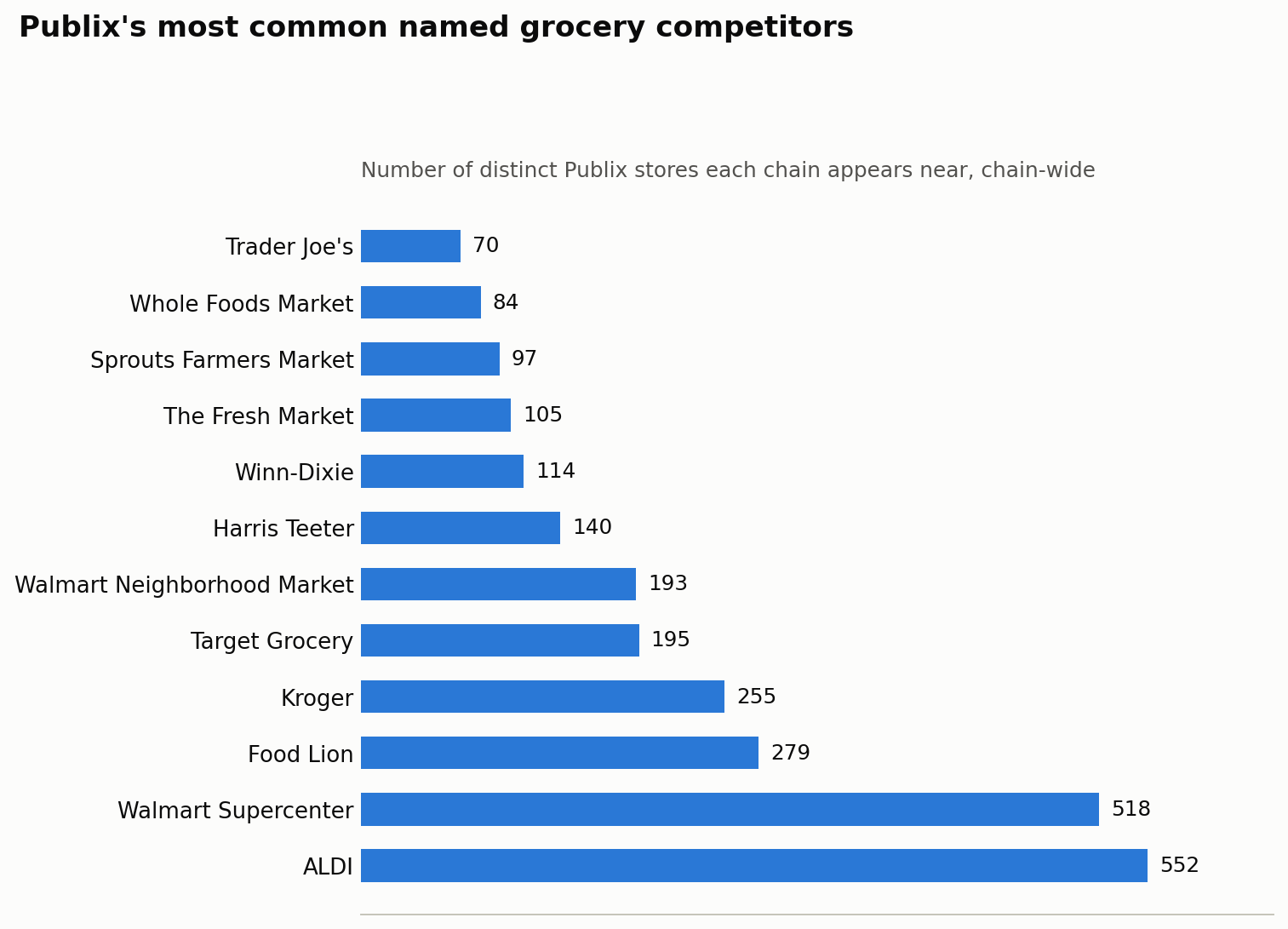
By name, ALDI and Walmart Supercenter show up near the most stores, followed by Food Lion, Kroger, and Target's grocery department.
Two other real patterns worth knowing. Large chains often show up as several separate Google listings for one physical store — Walmart alone appears under seven different listing names (Supercenter, Neighborhood Market, Deli, Pharmacy, Bakery, Grocery Pickup, and bare "Walmart"), and Kroger under six. And the "long tail" is genuinely long: of roughly 8,300 unique competitor names in the data, 72% appear near only one Publix store — a mix of real independent and ethnic grocers, plus some noise (shopping-center listings, and the occasional unrelated business Google's category search sweeps in by mistake).
Publix's own in-store departments — the pharmacy counter, the liquor store — often have their own, separate Google Maps listing, with their own rating, independent of the supermarket they sit inside. So do Walmart's and Kroger's. That means we can ask a question nobody usually asks: does the department do better or worse than the store itself?
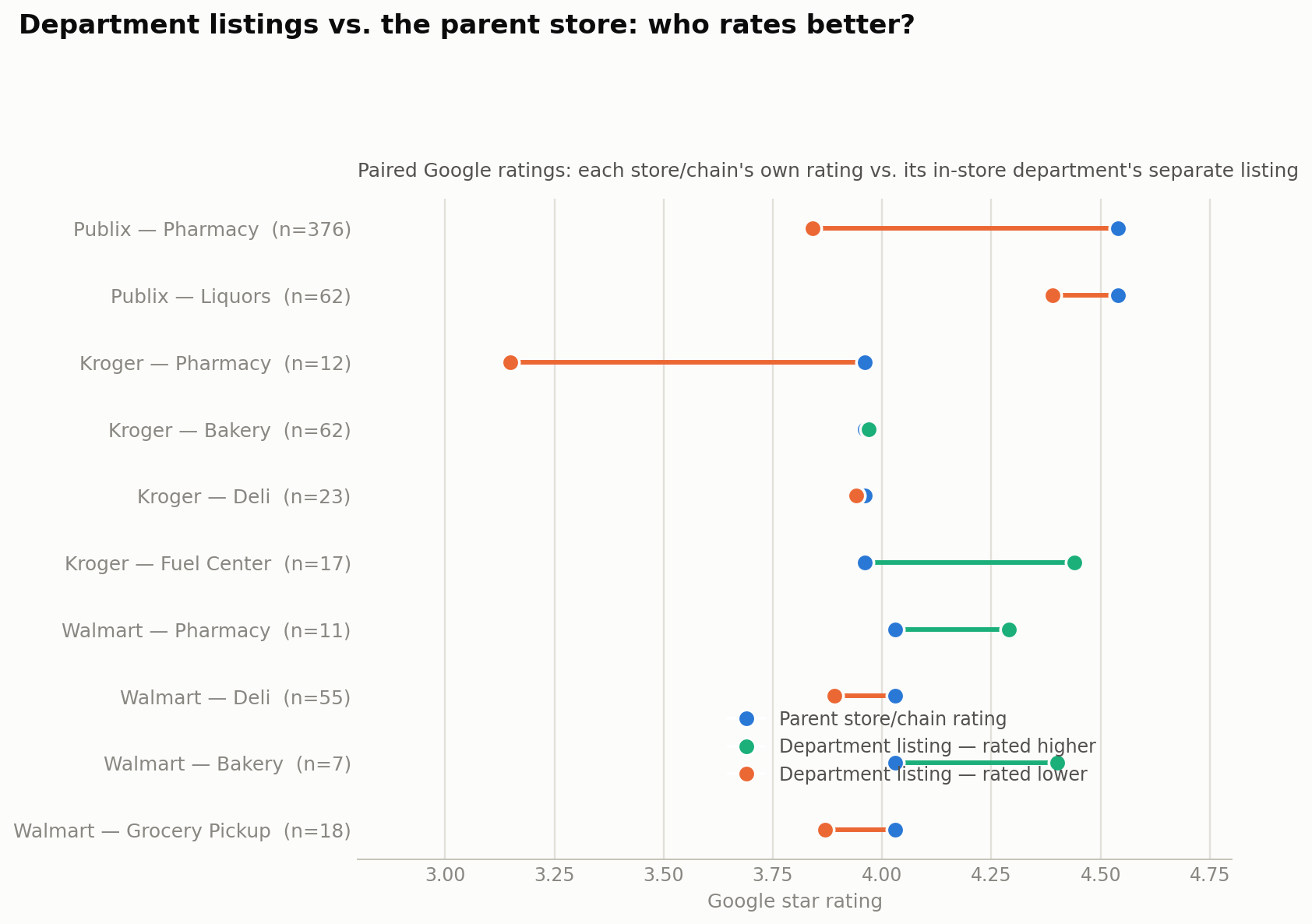
Publix Pharmacy is the standout finding here.
Across 376 stores where we could match a "Publix Pharmacy at [location]" listing to its own store's rating, the pharmacy rates lower than the store 87% of the time — by three-quarters of a star on average. That's a large, consistent gap on a genuinely large sample, and it lines up with an obvious explanation: pharmacy interactions (insurance, wait times, prescription problems) generate friction that grocery shopping mostly doesn't. Publix Liquors shows the same direction but far more mildly — rated lower than its store 61% of the time, by about 0.19 stars on average.
The pattern isn't universal, though, which is what makes it interesting rather than obvious. Kroger's pharmacy listings (a much smaller sample, 12 stores) show the same steep drop — down 0.83 stars on average. But Walmart's pharmacy listings don't: they're essentially flat against the parent Supercenter (+0.04 stars), and Kroger's Fuel Centers actually out-rate the parent store by a third of a star. Departments tied to a genuinely different kind of transaction — pharmacy above all — tend to drag the rating down; departments tied to a faster, simpler transaction (gas, bakery pickup) don't.
Google tags many competitors with a specific cuisine or origin — "Indian grocery store," "Korean grocery store," "Kosher grocery store," and similar — which lets us break the "ethnic and international grocery" category down by what it actually is, using Google's own classifications rather than a guess from the business name.
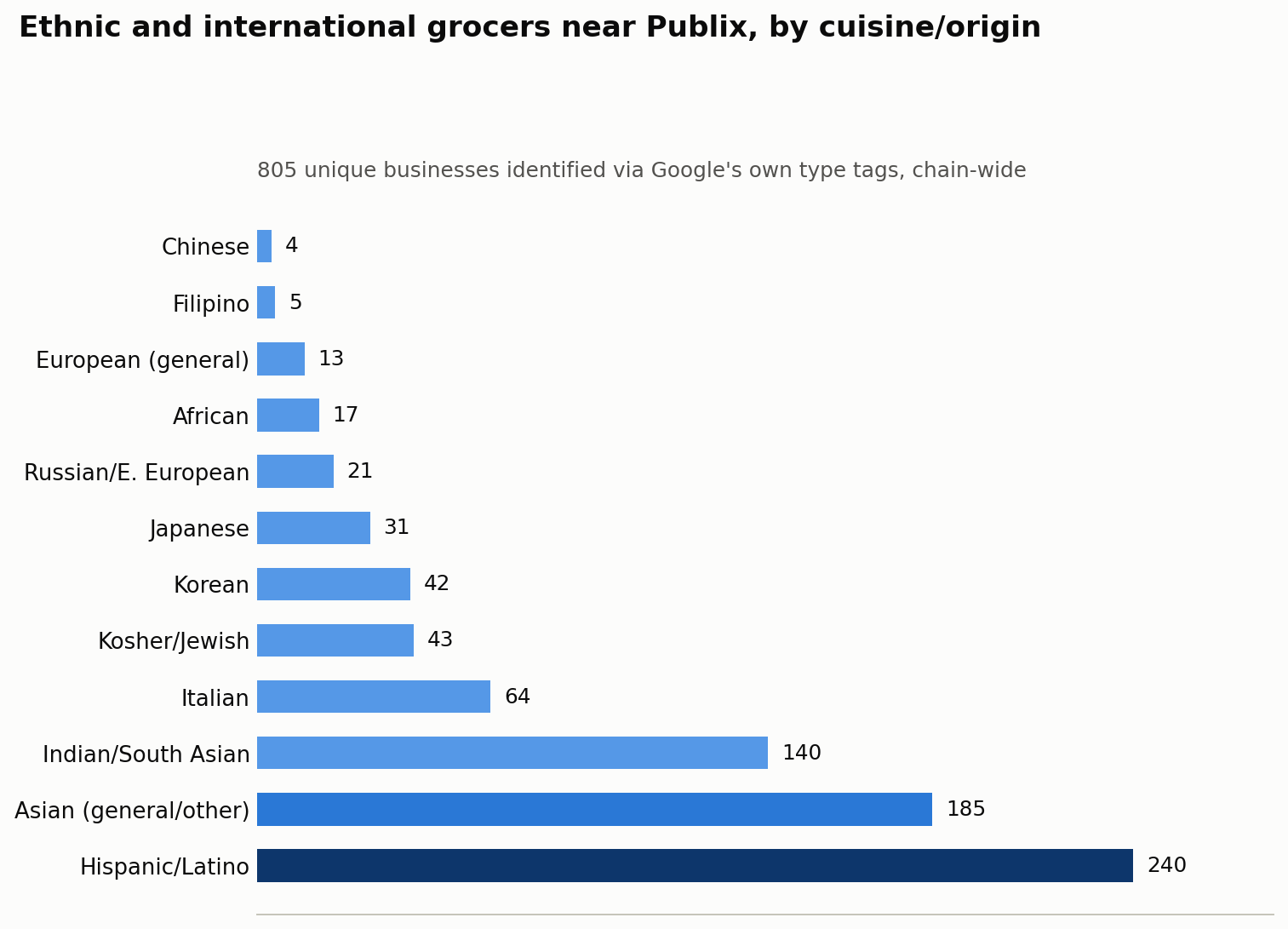
Across 805 such businesses identified chain-wide, Hispanic/Latino grocers are the largest single group (30%), followed by a broad "Asian" bucket (23%) and Indian/South Asian grocers specifically (17%) — together, South and East Asian grocers make up more of this category than any other regional grouping. Italian markets (8%) and kosher grocers (5%) round out the next tier. This mix roughly tracks Publix's own footprint: heavy in Florida, where Hispanic and Caribbean grocers are especially common, with meaningful South Asian and Korean representation concentrated around the chain's larger metro markets (Atlanta, Orlando, Tampa).
Every Publix location's Google listing carries its own attribute tags — accessibility, payment methods, pickup and delivery options — which gives a real, chain-wide read on what Publix actually offers, independent of any one store's marketing copy.
Free and paid lots split almost evenly, with free street parking rare — consistent with a chain built around dedicated shopping-center lots.
Florida and Georgia carry three-quarters of the chain and read as fully mature markets. The newer states tell a very different story.
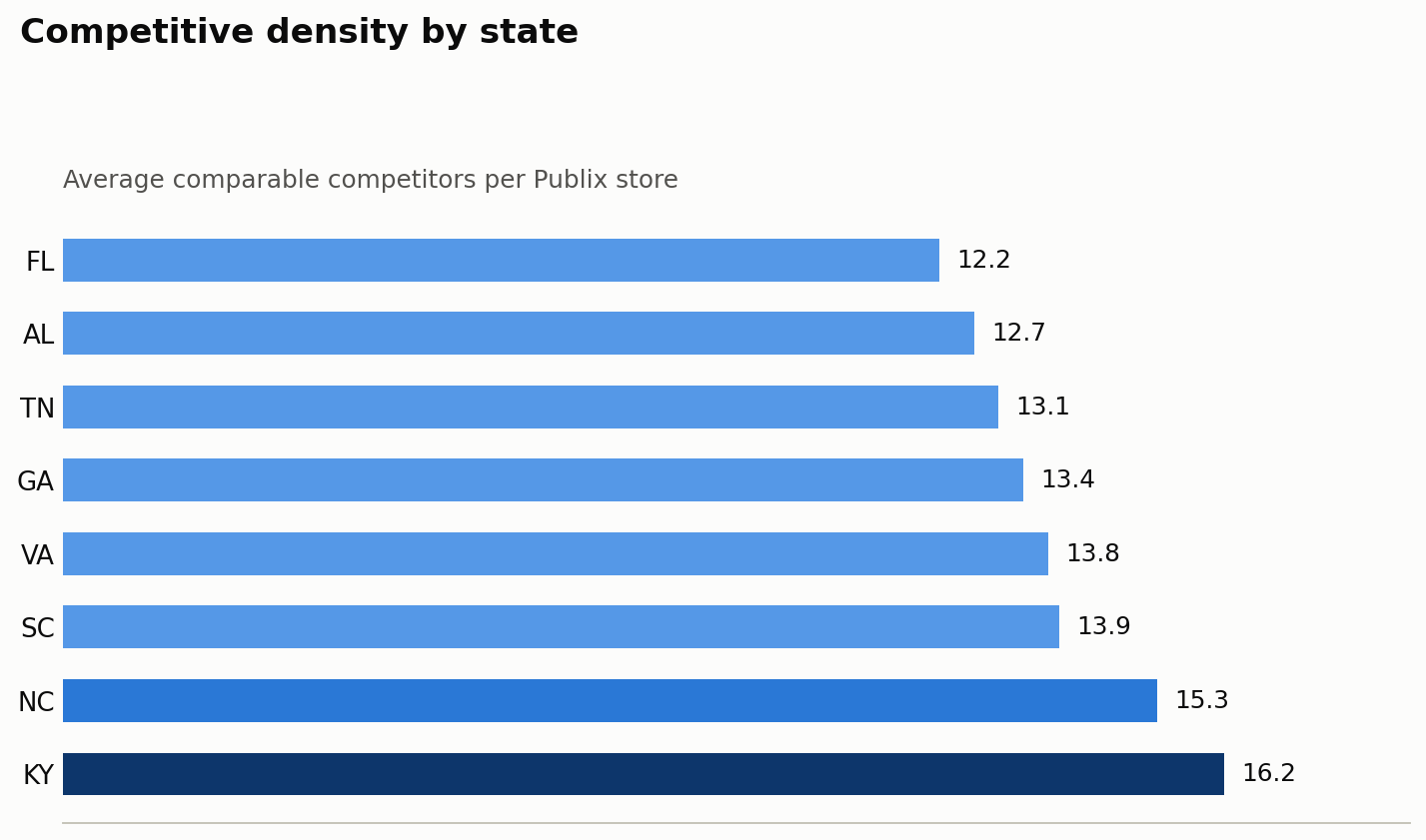
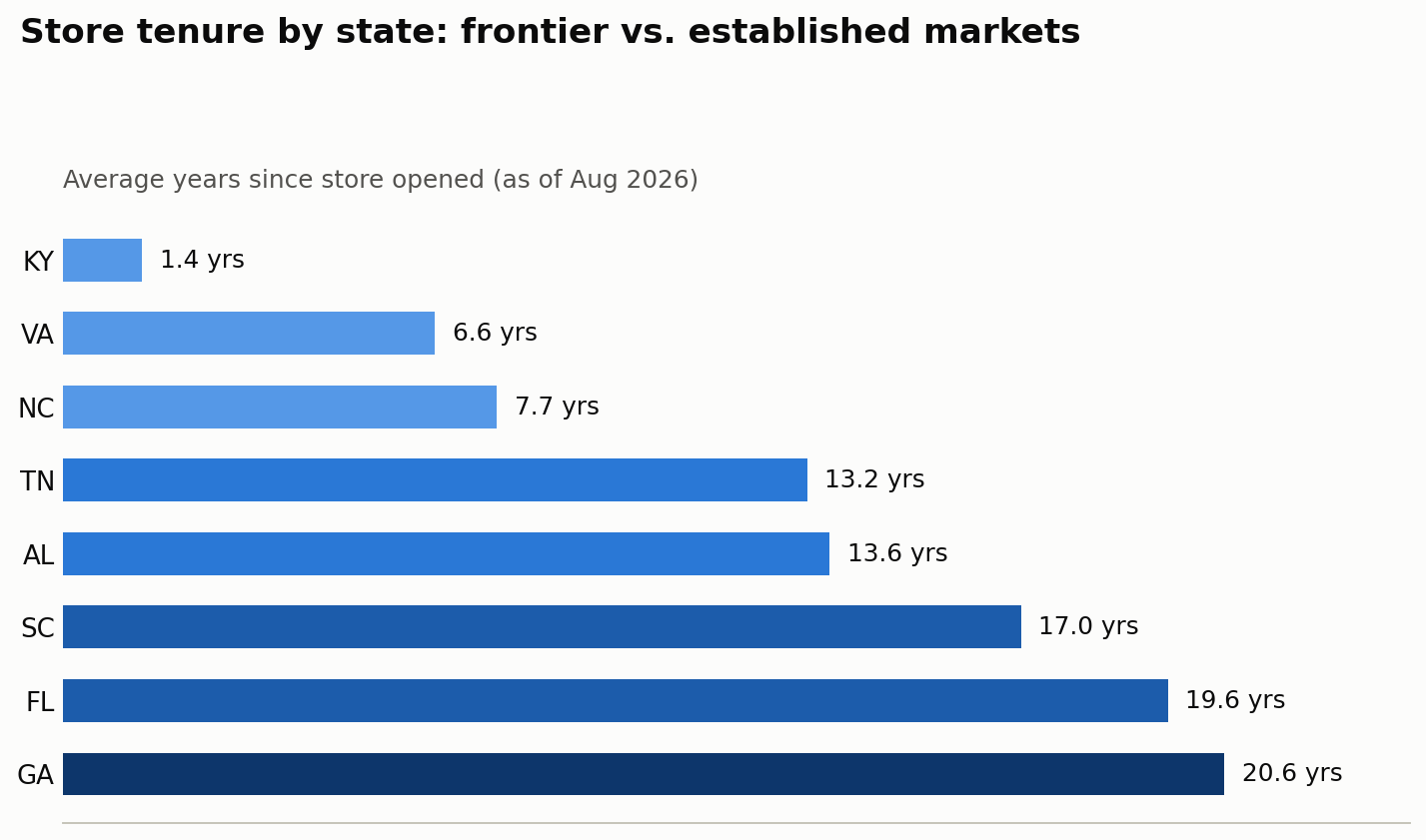
Florida and Georgia carry three-quarters of the chain and read as fully mature markets, with average store tenures of 19.6 and 20.6 years. The newer states tell a different story: North Carolina (7.7 years average tenure) and Virginia (6.6 years) are recent, fast-growing entries, and Kentucky is brand new — 9 stores averaging under a year and a half old. North Carolina in particular combines recent entry with real density (15.3 average comparable competitors, the second-highest in the footprint, and the shortest average distance to the nearest one at 298 meters) — Publix is entering already-crowded markets there, not open ground.
82 stores in this dataset opened in the last two years, spread across every state in the footprint. At the city level, Miami (38 stores), Orlando (35), Jacksonville (30), and Tampa (26) anchor the densest concentrations; Atlanta (22) is the only non-Florida city in the top five. Twenty-nine stores nationwide have zero comparable competitors nearby at all — genuinely uncontested locations, worth a second look for site selection.
The median Publix rates 4.6 stars, and the whole chain barely spreads beyond that.
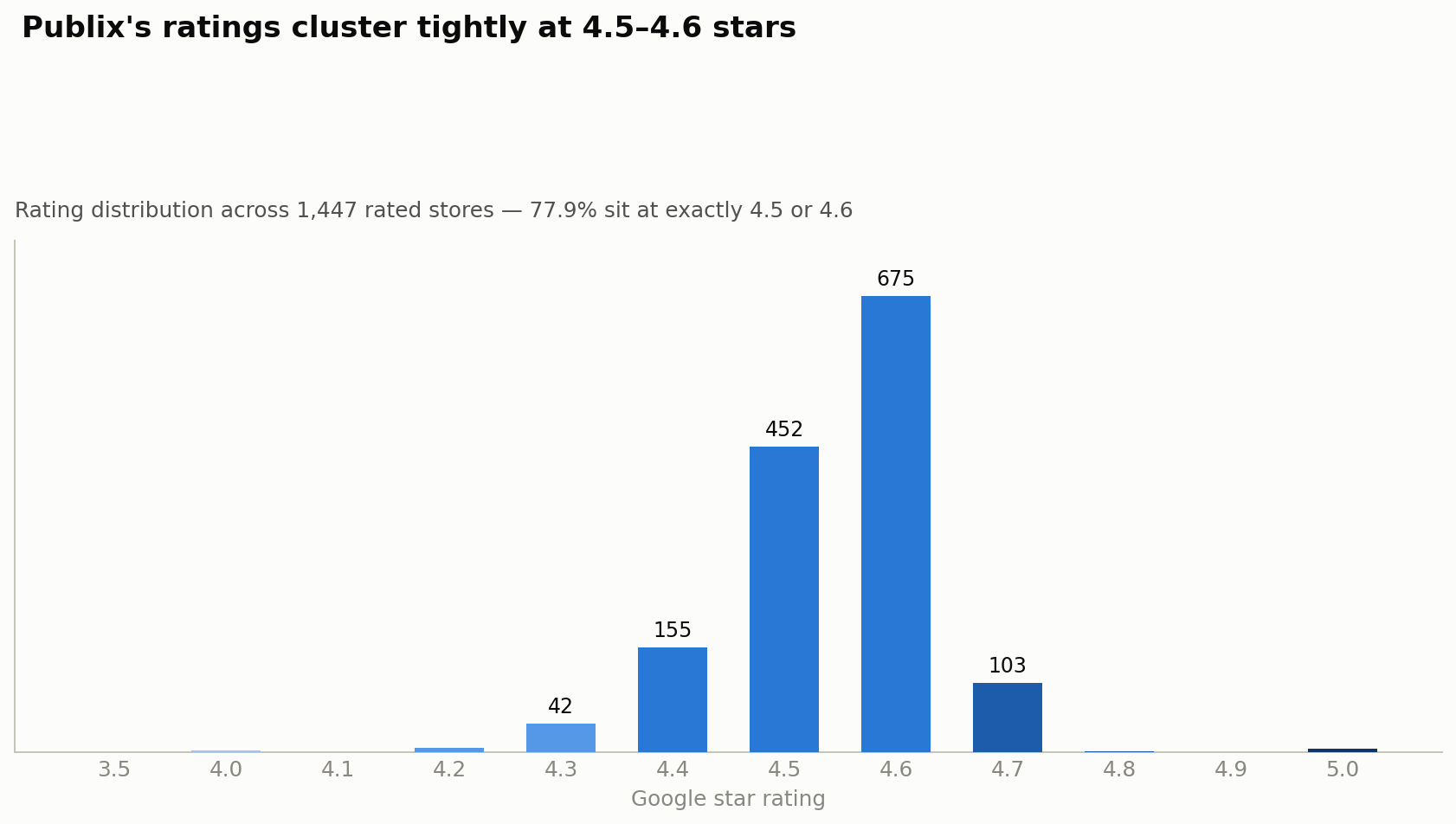
As the chart shows, 78% of the 1,447 rated stores land at exactly 4.5 or 4.6. Ratings run from 3.5 to 5.0 overall.
| Store | City, State | Rating | Reviews |
|---|---|---|---|
| Westlawn | Murfreesboro, TN | 4.8 | 417 |
| Downtown Doral | Doral, FL | 4.7 | 3,056 |
| Loughman Crossing | Davenport, FL | 4.7 | 2,817 |
| Lake Nona Creekside | Orlando, FL | 4.7 | 2,532 |
| Shops at Perdido Key | Pensacola, FL | 4.7 | 2,294 |
| Store | City, State | Rating | Reviews |
|---|---|---|---|
| Bal Harbour Square | Ft. Lauderdale, FL | 3.5 | 123 |
| Piedmont | Atlanta, GA | 4.2 | 3,269 |
| Princeton Lakes | Atlanta, GA | 4.2 | 3,257 |
| Highland Square | Jacksonville, FL | 4.2 | 2,842 |
| Belmart Plaza | West Palm Beach, FL | 4.2 | 427 |
Even the "lowest-rated" stores here sit at 4.2 or above, with a single outlier well below the pack (Bal Harbour Square, 3.5). In a chain this consistent, the bottom of the leaderboard mostly means "very good, not exceptional" rather than "underperforming."
With store-open-date data available for 1,432 of 1,450 stores — spanning a 1959 West Palm Beach location to a June 2026 opening in Bradenton — two patterns hold.
Store age has a weak negative correlation with rating — newer stores skew very slightly higher. More notably, review growth per year open has a moderate negative correlation with age: newer stores accumulate reviews faster than older ones, chain-wide averaging 152 reviews per year of operation.
Every finding above comes from real, live-pulled Google Maps data across close to the full chain — 1,486 of 1,487 stores with competitive-density data, 1,450 with clean attribute data, across all eight states Publix operates in. That's also the limit of what a content piece can responsibly show. The store-level detail behind these numbers — full address, phone, hours, the complete attribute set per store — is exactly what a granular location dataset is for.
This analysis draws on Google Maps data for 1,487 Publix locations across FL, GA, AL, SC, NC, TN, VA, and KY: a place-detail fetch for each Publix store (attributes, rating, review distribution), and a "grocery store" category search run from each store's coordinates, returning nearby businesses with their own name, rating, review count, and type tags.
Of 1,487 stores, 1,486 returned usable search data and 1,458 a confirmed place-detail match; 8 of those were further excluded after an automated check found they'd matched an in-store department listing (a pharmacy or bakery counter) rather than the supermarket itself, leaving 1,450 stores in the core attribute analysis. Review-count data was available for 1,029 of those stores (71%); the ratings leaderboard restricts further to the 1,015 stores with 100+ reviews.
Chain-composition figures use a rule-based classifier matching Google Maps type tags and business names against a curated grocery-format list (supermarket, grocery store, warehouse store, produce market, farmers market, health food store, and similar) and an exclusion list (convenience store, gas station, pharmacy, shopping mall, and similar). To check that classifier's blind spots, the 300 most frequent competitor names in the data (54% of all 23,851 name-occurrences, across 15,527 unique competitor listings chain-wide) were separately classified by direct name-and-type-tag review. The two methods disagreed on 14% of occurrences — mostly the rule-based filter over-counting non-grocery businesses that carry a grocery-adjacent type tag (Dollar General, vitamin shops, a pet-supply chain, a home-goods retailer), and occasionally under-counting a real competitor whose type tags don't exactly match the filter's keywords (Sam's Club). The competitor bar chart reflects the corrected reading; the aggregate density and chain-composition percentages elsewhere in this piece still reflect the full-population rule-based classifier, run across all 1,486 stores rather than the 300-name sample.
The ethnic/international grocery breakdown uses Google's own cuisine/origin type tags (e.g. "Indian grocery store," "Korean grocery store") directly, across all 15,527 unique competitor listings — a full-population read, not a sample.
Sub-listing (department) ratings were matched to their parent by finding, within each store's own search results, a "[Chain] Pharmacy/Deli/Bakery/etc." listing and its nearest matching parent-format listing in that same result set, then comparing the two ratings directly; Publix pharmacy/liquor listings were paired specifically to their own store's authoritative place-level rating. Store attributes (accessibility, payment, service, parking) are read from each store's Google "details" tags, normalized for hyphenation and regional spelling differences. Store age comes from an independent store-open-date field, not Google Maps.
Not included in this pass: deep per-competitor attribute profiles (for a full service head-to-head), footprint/square-footage estimates, and Census-based urban/suburban tier classification — each would require a separate data pull beyond what's used here, and none are estimated or assumed in their absence. Data collected August 20–21, 2026.
1,487 total in the manifest; 1,486 have usable competitive-density data and 1,450 have clean attribute data, across Florida (900 analyzed), Georgia (219), Alabama (97), South Carolina (74), North Carolina (64), Tennessee (62), Virginia (25), and Kentucky (9).
16.0 nearby grocery-tagged businesses on average, or 12.8 after filtering out convenience stores, gas stations, pharmacies, and shopping-center listings.
No — independent, single-location operators are the largest group (46%), narrowly ahead of national chains (41%); regional/local chains make up the rest (13%).
No. Across 376 matched stores, Publix Pharmacy listings rate lower than their own store 87% of the time, by 0.72 stars on average (3.84 vs. 4.54). Publix Liquors shows a smaller version of the same gap (rated lower 61% of the time, by about 0.19 stars).
Partly. Kroger's pharmacy listings show a similarly steep gap (-0.83 stars, though on a much smaller 12-store sample). Walmart's don't — its pharmacy listings rate essentially even with the parent Supercenter.
Of 805 ethnic/international grocers identified via Google's own cuisine-specific type tags, Hispanic/Latino grocers are the largest group (30%), followed by Asian grocers broadly (23%) and Indian/South Asian grocers specifically (17%), with Italian (8%) and kosher (5%) markets next.
Very — 99.6% have a wheelchair-accessible entrance, 99.6% accessible parking, 99.5% an accessible restroom. Wheelchair-accessible seating is much less common (10%).
Median 4.6 stars; 78% of the 1,447 rated stores land at exactly 4.5 or 4.6. Full range: 3.5 to 5.0.
Kentucky is the newest market — 9 stores averaging under 1.5 years old. Virginia (6.6 years) and North Carolina (7.7 years) are also recent. 82 stores in this dataset opened in the last two years, across every state in the footprint.
This article doesn't publish a per-store table with address, phone, and hours. The complete dataset is at Specrom's Publix store locations page.
1,487 locations · 8 states · 29 data fields · CSV format · Updated 2026
Get the Full Dataset