
A store-level look at direct-competitor share, named rivals, chain composition, and the geography of reviews and competitive density across all 1,229 Michaels locations — built from real Google Maps "Craft store" search results run from each store's own coordinates.

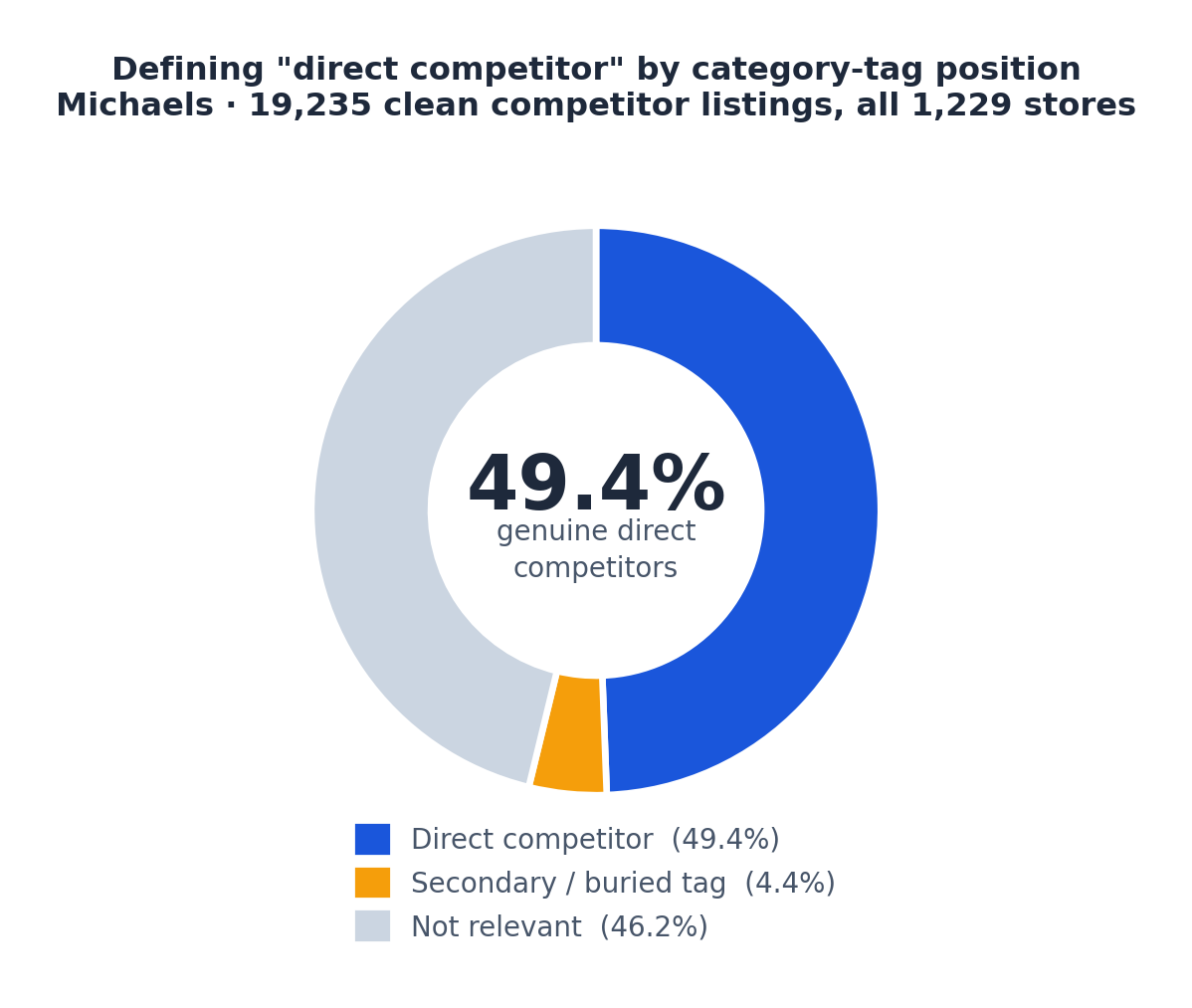 Only half of what Google surfaces for "Craft store" near a Michaels is a genuine craft competitor — the rest is a buried tag or no craft relevance at all.
Before judging anyone else's Google listing, it's worth establishing what Michaels' own listing looks like across all 1,229 stores — the baseline every comparison in this piece is measured against.
Across the 1,222 self-listings found, Michaels' own types tags collapse into only 8 distinct combinations chain-wide, and 79.3% of stores use the exact same one (Craft store | Art supply store | Balloon store | Christmas store | Fabric store | Hobby store | Party store | Picture frame shop | Scrapbooking store | Yarn store). Description text is even tighter — just 3 distinct combinations, with 94.9% of stores sharing the identical tagline and long-form write-up. The exceptions are worth naming plainly: 55 of the 1,222 self-listings (4.5%) carry no description at all.
Rather than lean on a subjective core/adjacent/not-relevant call, this piece scores every competitor listing by where a craft-relevant tag sits in that listing's own Google-assigned types array — which, on inspection, preserves real category-ranking order: Hobby Lobby's own tags lead with Craft store, Fabric store, Hobby store; OfficeMax's tags lead with Office supply store and never mention anything craft-related at all.
The core-tag list itself is data-driven, not hand-picked: a tag qualifies as "craft-core" only if it appears as a listing's first tag at least 15 times across the pull, and at least 85% of the listings where it leads agree with the manual/LLM-reviewed core-relevant classification. That process surfaced 26 tags.
For every competitor row, we find the first position (1-indexed) in its types list matching one of those 26 tags. No match anywhere — not relevant. A match at position 1–3 — direct competitor. A match buried at position 4 or later — secondary/partial match. Applied to the 19,235 competitor listings in this pull (a small number of geographic outliers and Michaels' own in-store listings are screened out first — see Methodology): 49.4% (9,507) score as direct competitors, 4.4% (845) as secondary matches, and 46.2% (8,883) carry no craft-relevant tag anywhere.
Ranked by how many distinct Michaels stores each name appears near as a direct-tier competitor.
Hobby Lobby leads by a wide margin — a real nearby competitor to 930 stores (75.7% of Michaels' 1,229), built from 745 distinct real Hobby Lobby locations across 47 states, a footprint on the same order as Michaels' own. Well behind it: Blick Art Materials, pOpshelf (whose own reviewed format bucket is "Mall / Department / Discount," not a true craft specialty), HobbyTown, Warhammer, Paper Source, Lakeshore Learning Store, and Color Me Mine, a paint-your-own-pottery studio format rather than a supply retailer. Everyone past that top handful drops into single digits to low teens of stores reached — several of them, like Grace Craft Shop and The Compleat Sculptor, built from a single real location that happens to sit near many Michaels stores rather than a genuine multi-location chain.
That leaderboard is the direct-tier view specifically — a separate, format-level cut of the same clean competitor rows tells a different story about what Google surfaces overall. Genuine craft/hobby/art specialty retailers are the largest format bucket at 41.8%, but the second-largest, at 23.3%, is "Other / Not Craft-Relevant" — Dollar Tree, Barnes & Noble at its buried tag position, Harbor Freight, and similar names swept in by Google's local search despite selling little to nothing craft-related. Mall/department/discount retailers (8.7%, largely pOpshelf and Kohl's-type stores) and gift shops (5.2%) are the next-largest buckets after that.
At 513 Michaels stores where both the store's own rating and its in-store Michaels Custom Framing listing's rating are available, the two can be compared directly, store to store, rather than as two disconnected averages.
The framing listing rates lower than its own host store 53.8% of the time (276 stores), higher 39.0% of the time (200), and ties 7.2% of the time (37). That's the same direction as a pattern this series has seen before — Publix Pharmacy rated lower than its own host store 87% of the time, by 0.72 stars on average — but far milder here. A framing counter tucked inside a craft store doesn't generate anywhere near the same customer-friction gap a pharmacy counter does.
Michaels' own listing was found in the top 20 results in 99.1% of its own searches, at an average rank of 1.16 once found — comfortably inside a healthy target band, which is why this isn't the article's headline.
86.2% of all searches placed Michaels at rank #1 outright, and 97.9% placed it at #1 or #2. The more interesting story is the 164 searches (13.4%) where the top spot went to somebody else. Hobby Lobby took the #1 slot away 33 times and pOpshelf did it 32 times — between them, roughly 40% of every occasion Michaels lost the top spot outright. The most striking single case: in Denton, TX, Michaels ranks a startling #15, behind Thistle Creative Reuse (4.8 stars, 251 reviews), The DIME Store (4.8, 134 reviews), and Denton Maker Center (5.0, 13 reviews) — three small, highly-rated local names outranking the national chain in its own backyard search.
At the other end, 11 stores (0.9%) never surfaced Michaels' own listing anywhere in the top 20. Five of those — Twin Falls, ID; Southfield, MI; Chelmsford, MA; Ventura, CA; and Mansfield, TX — came back with a genuinely empty search result set. The other six — Richmond, TX; Aiken, SC; Sunrise, FL; Alabaster, AL; San Antonio, TX; and Sandusky, OH — returned a full page of 20 results with no confident Michaels match among them, which more likely signals an unclaimed or non-standard Google Business Profile than an actual missing store. Sandusky is a known, specific case: that store's real self-listing uses the non-standard name "Michaels - Sandusky" rather than the pattern the matching logic expects — see Methodology.
A genuine store-density signal distinct from anything about outside competitors — how often does Google's own fixed-radius search catch more than one Michaels location at once?
696 of Michaels' 1,229 stores (56.6%) saw at least one sibling Michaels location surface in their own search results, and 363 (29.5%) saw two or more. The distribution runs up to four stores — in Delray Beach, FL; Riverside, CA; Tampa, FL; and Boca Raton, FL — where the search surfaced five sibling Michaels locations plus the origin store itself: six total Michaels listings competing for the same 20 slots. In south Florida and inland Southern California specifically, Michaels' own footprint is dense enough that Google's fixed search radius routinely catches more than one location of the chain itself.
Michaels' own review counts and its competitive density both vary meaningfully by state. The table below is fully sortable — click any column header to re-rank all 50 states plus DC.
| State | Stores | Avg. Reviews / Store | Avg. Direct Competitors |
|---|
• = fewer than 5 stores in that state (AK, RI, ND, SD, VT, WY, DC) — shown for completeness, but too thin to read as a real regional signal. n=1,224 stores with state-level data.
Review volume concentrates in the Southwest and parts of the South: Arizona (32 stores, averaging 1,209.8 reviews), Washington (27, 1,209.3), Oklahoma (8, 1,204.1), South Carolina (17, 1,203.5), and Oregon (16, 1,199.5) sit at the top. West Virginia sits at the low end (9 stores, 434.0 reviews) alongside Connecticut (23, 507.1). Competitive density tells a related but distinct story: Nebraska's 6 stores average 13.0 direct competitors each — the densest in the dataset among states with more than a handful of stores — followed by Oklahoma (10.62) and Idaho (10.20), while Delaware (4.43) and New Hampshire (5.25) sit at the low end. One pattern holds across every large state: Hobby Lobby is the single most common named competitor in every one of the ten states with the most Michaels stores (California, Texas, Florida, New York, Pennsylvania, Virginia, Ohio, Illinois, North Carolina, and Michigan) — no state-level exception to Hobby Lobby's national reach among Michaels' biggest markets.
Before leaning on review count as an age proxy for competitors, we checked that logic against Michaels' own stores — where real open-date data exists.
Age has essentially no correlation with rating, but a real, if modest, negative correlation with reviews accumulated per year open — newer stores rack up reviews faster per year than older ones, averaging 58.3 reviews per year open chain-wide. Reviews-per-year-open is a defensible tenure signal for competitors, whose true open dates aren't known; raw review count on its own, or rating, is not.
Competitors rate modestly but consistently higher than Michaels across every cut — while Michaels' own review volume dwarfs the median competitor's.
Michaels' own stores average a 4.33 rating (n=1,222) against 4.60 for all competitor listings (n=18,767) and 4.64 for competitors scored as direct-tier specifically (n=9,820). Review volume runs the opposite direction and far more dramatically:
Michaels stores are established, high-traffic locations relative to the median competitor storefront, even though competitors edge out Michaels on star rating.
Photo counts look like a Michaels advantage (8.93 vs. 7.61) but that gap is very likely a collection artifact, not a real content difference: Michaels' own listings were pulled with an observed photo cap of 10, with only 0.1% of listings sitting at that max, while competitor listings show an observed cap of 9, with 77.5% of listings bunched right at that ceiling. This comparison isn't a fair read on which side actually posts more photos.
Every number in this piece comes from a real, live-pulled Google Maps "Craft store" search run from the exact coordinates of 1,229 Michaels stores — not a sample, not an estimate. That's also the natural limit of what an article like this should show in full: the complete per-store detail behind these numbers — address, phone, hours, and every individual competitor's full listing — is exactly what a granular location dataset is for.
Search parameters. Google Maps local category search for "Craft store," zoom level 13, top 20 results per search, run from each of Michaels' 1,229 stores' own coordinates (not a fixed radius). Data collected 2026-08-24.
Store and file counts. 1,229 JSON search-result files found; 1,224 loaded successfully with zero parse failures; 5 came back with a genuinely empty result set. Total listing-appearance rows across all searches: 23,263.
Self and sibling matching. A listing is treated as "Michaels" if its name matches "Michaels" or "Michael's" (optionally followed by "Store(s)"), case-insensitively, or its website contains locations.michaels.com. Its store ID is resolved via URL-exact match first (99.6% of confidently-matched self-listings), a geo-distance fallback within 0.3 miles second, with unmatched listings kept as their own category. The Sandusky, OH exception — a store whose true self-listing uses the non-standard name "Michaels - Sandusky" — is a known, specific limitation of the name-matching pattern.
Two-stage classification. A draft rule-based classifier tagged all 1,498 distinct Google types tags on competitor listings as core-relevant, adjacent, or not-relevant. The 341 tags occurring 20+ times (92.4% of all tag occurrences chain-wide) were reviewed individually by hand; the remaining ~1,157 low-frequency tags were classified with a keyword-pattern rule engine, then QA'd for false positives (catching bugs like "craft" matching inside "watercraft," or "rug store" matching inside "drug store"). Final tag split: 68 core-relevant, 130 adjacent, 1,300 not-relevant. Of 13,258 distinct competitor names, 359 flagged as multi-location chains were hand-classified using real-world brand knowledge; the remaining 12,899 singletons were corrected only where their own Google tags, re-run through the reviewed tag logic, produced a different result than the draft — 2,269 corrections, each with a reviewer note.
Classification review coverage. 34.2% of all competitor listing rows trace to a name-level hand review; the remaining 65.8% fall back to the tag-level classification. High-volume chains get reviewed individually far more often, relative to their 2.7% share of distinct names, than that share would suggest.
Direct-competitor tag list and cross-validation. The 26-tag core-craft list was built by requiring a tag to lead a listing's types array at least 15 times and agree with the manual core-relevant classification at least 85% of the time. Cross-checking the resulting position-based tiering against the independent manual review: among manually-reviewed rows judged core-relevant, 95.2% land in the mechanical direct-competitor tier; among rows judged not-relevant, 83.8% land in the mechanical not-relevant tier. Known exceptions are mostly museums, art studios, and schools that carry an art-related category tag without being a retail competitor.
Geographic-artifact removal. 19 names, together accounting for 1,065 listing-appearances (1–2 real addresses each, averaging 165–1,008 miles from the origin store), were excluded from every leaderboard, percentage, and chart in this piece.
Known limitations. 122 of 359 hand-reviewed chains (34.0%) remain classified "unsure" on real-world footprint. The 2,269 singleton corrections are systematic, not individually verified by eye. A.C. Moore, a former Michaels competitor, closed in 2020 with some locations converting to Michaels itself — any lingering A.C. Moore listings are very likely stale Google data. Photo counts were collected with an uneven cap (see Ratings section), and review count is used only as a rough, correlation-checked tenure proxy for competitors, never as a satisfaction signal.
All 1,229 Michaels store locations. 1,224 category searches (99.6%) returned usable results, producing 23,263 total listing-appearances.
A competitor listing whose Google types array carries a craft-relevant category tag (one of 26 data-driven core tags) within the first three positions of its own ordered tag list — a mechanical, reproducible rule rather than a subjective judgment call. Applied across the pull, 49.4% of competitor listings qualify.
Hobby Lobby, by a wide margin — a real nearby direct-tier competitor to 930 of Michaels' 1,229 stores (75.7%), built from 745 distinct Hobby Lobby locations across 47 states, averaging a 4.50 rating.
53.8% (direct-competitor plus secondary-match combined) once scored by category-tag position; the remaining 46.2% carries no craft-relevant tag at all.
Found in the top 20 in 99.1% of searches, at rank #1 in 86.2% of them, and at rank #1 or #2 in 97.9% — a healthy target band, which is why this piece treats it as a KPI check rather than a headline finding.
56.6% of stores (696 of 1,229) saw at least one sibling Michaels location, and 29.5% (363) saw two or more. Four stores — Delray Beach FL, Riverside CA, Tampa FL, and Boca Raton FL — saw five siblings plus themselves.
Slightly worse, on average. Across 513 stores with both ratings available, Michaels Custom Framing rates lower than its own host store 53.8% of the time, by 0.14 stars on average (4.19 vs. 4.33) — the same direction, but far milder, than the 0.72-star gap this series found between Publix Pharmacy and its host store.
Slightly lower — 4.33 average for Michaels against 4.60 for all competitors and 4.64 for direct-tier competitors — though Michaels' median review count (914) far exceeds the median competitor's (110).
Nebraska averages the highest direct-competitor count per store (13.0), followed by Oklahoma (10.62) and Idaho (10.20); Delaware (4.43) and New Hampshire (5.25) sit at the low end among states with a meaningful store count.
This article doesn't publish a per-store table with address, phone, and hours. The complete dataset is at Specrom's Michaels store locations page.
1,229 locations · CSV format · built from the same pipeline as this article · updated 2026
Get the Full Dataset